
There are certain words capable of making an automotive apprentice immediately reconsider every life choice that brought them to this moment.
Refrigerant pressures. Thermodynamics. Heat pump.
Suddenly becoming a dog groomer doesn't sound half bad.
But before you throw your gauges into traffic, here's the good news: An EV heat pump is not some completely new magical automotive contraption.
If you understand how an air conditioning system moves heat, you're already much closer to understanding an EV heat pump than you probably think.
Because that is really what a heat pump does. It moves heat.
No engineering degree. No secret handshake. And I promise to use the word enthalpy exactly zero times.
1. What happened?
Electric vehicles created an interesting heating problem.
A gasoline or diesel engine produces a tremendous amount of heat while operating. Most of that heat is wasted energy, but when it is freezing outside that waste heat becomes very useful for cabin heating.
An EV does not have the same convenient source of engine heat. The electric motor, inverter, battery and other components can create some heat, but the vehicle does not have a giant internal combustion furnace under the hood producing enormous amounts of waste heat all the time.
One solution is an electric resistance heater. Electricity passes through a heating element, the element gets hot, air passes over it and the cabin gets warm.
Unfortunately, that electricity comes from the high voltage battery. The same battery being used to drive the vehicle.
Heat pumps can warm the cabin more efficiently than relying entirely on resistance heating under many operating conditions, helping preserve driving range in cold weather.
Manufacturers did not add heat pumps because automotive HVAC wasn't complicated enough already. Although I'm sure that helped. They added them because heat is energy, and EVs really do not enjoy wasting energy.
2. How does it work?
Heat does not have to mean something feels hot to you.
Even cold outside air contains thermal energy. Yes. Even Canadian winter air. I know it feels personally hostile when it hits you in the face at 6:30 in the morning, but there can still be thermal energy available for the system to use.
A heat pump uses a refrigeration cycle to move that heat from one place to another.
- Refrigerant
- Compressor
- Heat exchangers
- Expansion devices
- Temperature sensors
- Pressure sensors
- Valves
- Electronic controls
First, remember what your A/C system actually does
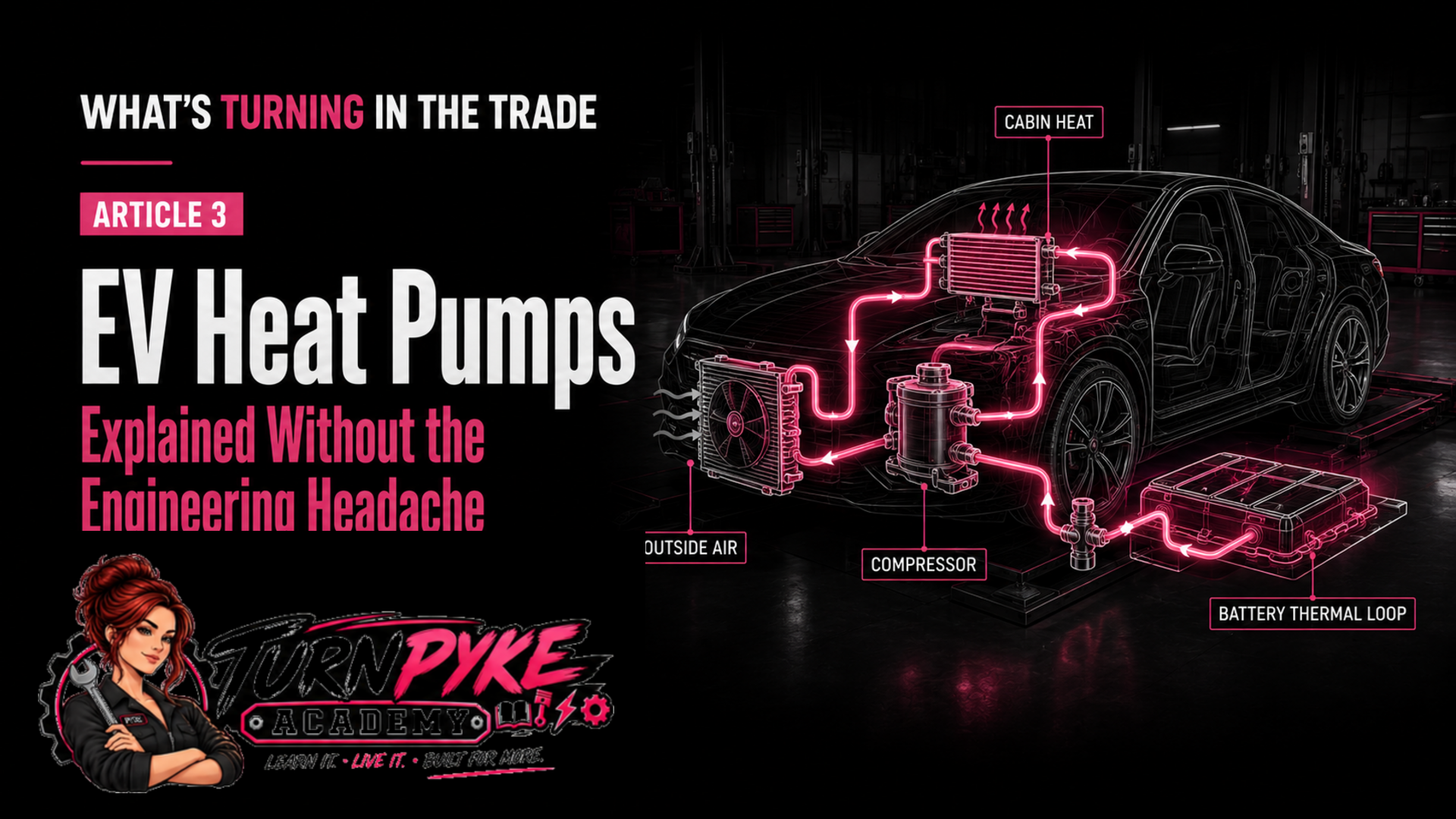
When you turn on conventional automotive air conditioning, the system is not really creating cold. It is removing heat from the passenger compartment and rejecting that heat somewhere else.
A heat pump takes that same basic idea and becomes much more creative about where the heat goes. Instead of always moving cabin heat outside, the system can be configured to capture available heat and move it into the cabin.
Depending on the vehicle design, the system may collect thermal energy from outside air, the high voltage battery, the electric motor, the inverter or other power electronics.
Which is basically the vehicle saying: “We are already making this heat. Might as well steal it.” Resourceful little bastard.
So how does refrigerant move the heat?
- The refrigerant absorbs thermal energy at a heat exchanger.
- The electrically driven compressor compresses the refrigerant, increasing pressure and temperature.
- The hot refrigerant releases heat at another heat exchanger where that energy can warm the cabin.
- The refrigerant passes through an expansion device, pressure and temperature drop, and the cycle begins again.
But how can the same system heat AND cool?
Valves can change the refrigerant path through different heat exchangers depending on what the vehicle needs.
- Cool the passenger compartment
- Heat the passenger compartment
- Cool the battery
- Warm the battery
- Move waste heat from one component somewhere useful
Or several of those things at approximately the same time because apparently HVAC technicians had too much peace in their lives.
Wait. What does the battery have to do with cabin heat?
Potentially quite a lot. Lithium ion batteries have a temperature range where they perform best. If the battery gets extremely cold, performance and charging capability can be reduced. If it gets too hot, that is also a problem.
- Coolant circuits
- Refrigerant circuits
- Chillers
- Electric heaters
- Heat pumps
- Pumps
- Valves
- Temperature sensors
- Software control
This can also connect to battery preconditioning. We are saving that rabbit hole for its own article so we do not emerge sometime next Thursday.
3. Why should technicians care?
An EV cabin heating complaint might not be just an HVAC complaint.
A conventional no heat diagnosis may involve coolant temperature, coolant level, thermostat operation, heater core flow, blend door position and airflow. An EV heat pump system can add high voltage electric compressors, switching valves, multiple temperature and pressure sensors, battery thermal management requests, electric pumps, resistance heaters, network communication and software strategy.
So the complaint “It does not get warm” may turn into a diagnostic adventure involving three control modules, two coolant loops and a valve buried somewhere engineers clearly never intended human hands to reach. Tuesday.
Do not assume the heat pump is always responsible for heating
EVs can use more than one heating method. Depending on operating conditions, the control module may request a heat pump, an electric resistance heater, or a combination.
HEAT PUMP BAD. REPLACE EXPENSIVE THING.
Not so fast. The first diagnostic question is: What is the system trying to do?
Cold weather changes things
As ambient temperature drops, extracting useful heat from outside air becomes more difficult. Manufacturers may capture waste heat, supplement with an electric heater, change refrigerant flow, modify compressor operation or alter battery and cabin heating priorities.
Do not memorize one temperature at which every heat pump supposedly gives up. Look up the manufacturer information.
Yes. We are doing this again. READ THE SERVICE INFORMATION is becoming the unofficial TurnPyke Academy national anthem.
Refrigerant service becomes even more important
- Correct refrigerant type
- Correct refrigerant quantity
- Proper recovery procedures
- Specified oil
- System cleanliness
- Leak diagnosis
- Manufacturer procedures
Close enough is not a refrigerant specification. There is no “Eh, she is probably got enough” setting on the machine.
And then there is high voltage
An electrically driven A/C compressor on a hybrid or EV may operate using the high voltage system. That immediately changes the safety conversation.
High voltage electric compressors can also have different oil requirements because electrical insulating properties may matter. Using the wrong lubricant or contaminating the system can be considerably more serious than “Whoops. Wrong bottle.” High voltage is not an area where we freestyle.
4. What should an apprentice remember?
A heat pump does not primarily make heat. It moves heat.
A resistance heater takes electrical energy and turns it directly into heat. A heat pump uses electrical energy to operate a refrigeration system that moves existing thermal energy somewhere useful.
EV thermal management is a system, not a single component.
Cabin temperature, battery temperature, power electronics temperature, refrigerant pressure, coolant temperature, ambient temperature, charging conditions and vehicle operating mode can all influence what the system decides to do.
So do not diagnose one sensor in isolation without asking: What is the system trying to accomplish right now?
Automotive diagnosis strongly discourages emotional decision making. Despite repeatedly provoking it.
5. The C of Q Connection 🔧
- Refrigeration cycle operation
- Compressor function
- Condenser operation
- Evaporator operation
- Pressure and temperature relationships
- Expansion devices
- Refrigerant states
- Heat transfer
- Temperature sensors
- Pressure sensors
- HVAC control strategies
- Series and parallel circuits
- High voltage safety
- Electric motors
- Scan tool data
- Diagnostic procedures
The fact that we are now using a refrigeration circuit to heat the vehicle does not suddenly repeal HVAC fundamentals. The refrigerant is still absorbing heat somewhere and releasing it somewhere else.
Do not memorize “this is EV heat pump stuff.” Connect it to “this is a refrigeration cycle being used differently.”
6. Sources
U.S. Department of Energy: Winterizing Your Electric Vehicle
Explains why heat pumps can warm EV cabins more efficiently than resistance heaters in many conditions and why some vehicles use both technologies.
https://www.energy.gov/articles/winterizing-your-electric-vehicle
Volvo Cars: Electric Vehicle Technology Explained
Explains how EV heat pumps can capture thermal energy while reducing battery energy consumption.
https://www.volvocars.com/en-ca/cars/electrification/
Hyundai: Electric Car Jargon Buster: Heat Pump
Manufacturer explanation of heat pump operation using familiar A/C components.
https://www.hyundai.com/uk/en/electrification/learn-more/jargon-buster.html
Kia: Heat Pump Technology
Manufacturer technical information describing waste heat recovery from electric powertrain components.
7. Next Step 🔧
DAILY TORQUE 🔧
A battery electric vehicle uses a heat pump to warm the passenger compartment in cold weather. What is the PRIMARY advantage of using the heat pump instead of relying entirely on an electric resistance heater?
A. It generates additional electrical energy for the traction battery
B. It transfers available thermal energy using less battery power for heating
C. It increases refrigerant pressure without operating the compressor
D. It eliminates the need for battery thermal management in cold weather
Correct Answer: B: It transfers available thermal energy using less battery power for heating
A heat pump uses the refrigeration system to move thermal energy into the cabin. It still requires electrical energy to operate, but it can deliver cabin heating more efficiently than relying entirely on electric resistance heating under many conditions.
A is incorrect because the system is not generating electricity. We have not achieved free energy. Please do not tell Facebook.
C is incorrect because the compressor is an important part of the refrigeration cycle.
D is incorrect because the traction battery still requires temperature management.
Apprentice takeaway: A heat pump moves heat. It does not create free energy, nor does it magically eliminate battery thermal management.
If HVAC currently feels like somebody took pressure, temperature, electricity and witchcraft, stuffed them into one textbook chapter and wished you luck: Hi. That is what tutoring is for.
At TurnPyke Academy, we break complicated systems back down into the fundamentals until they actually make sense. Because remembering that the answer was B might get you through one question. Understanding why it was B helps you answer the next twenty.
And eventually you might even stop hating HVAC. No promises.
Knowledge. Confidence. Drive.