
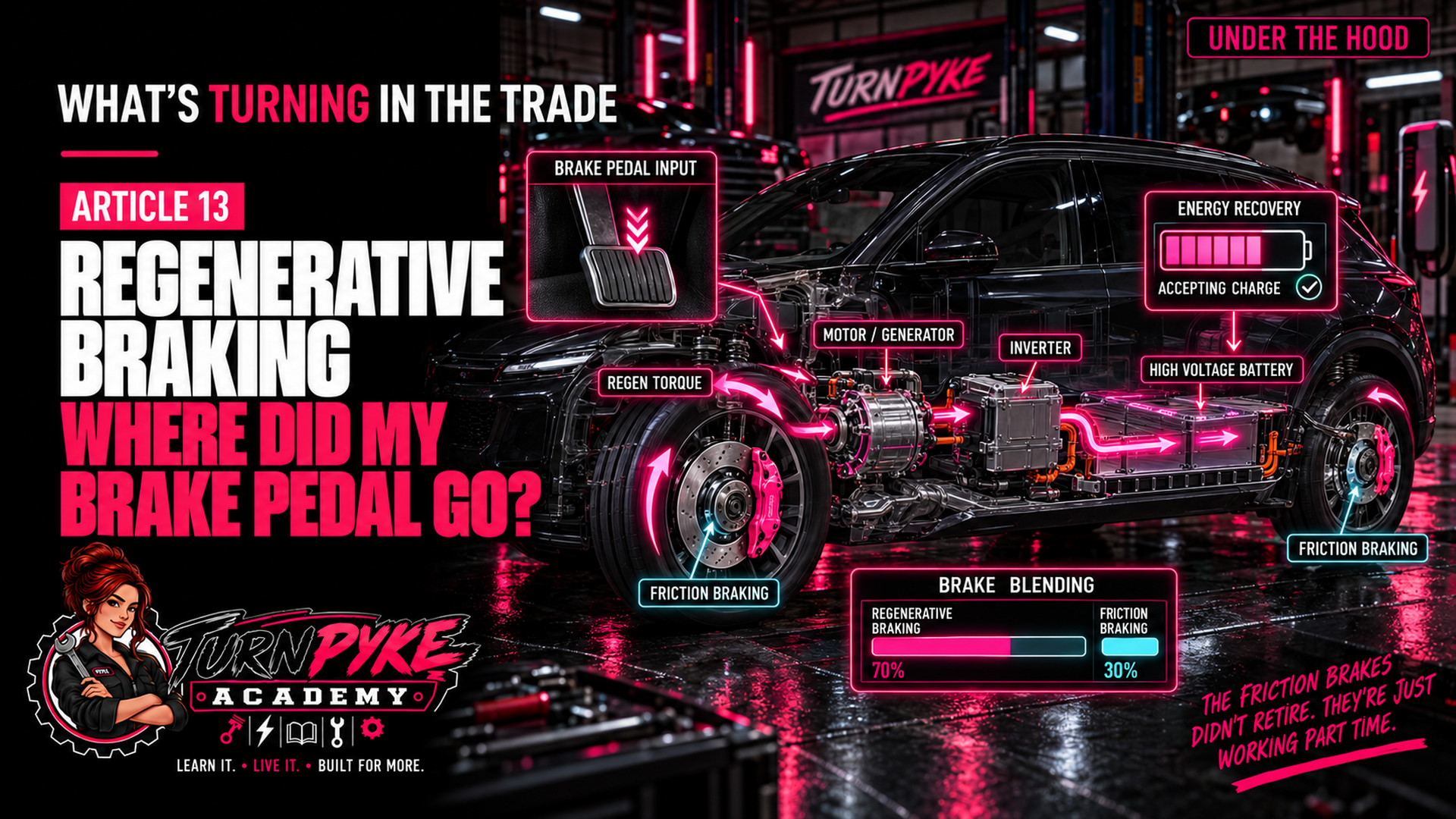
Normally, when you slow a vehicle down, all that lovely kinetic energy gets converted into heat at the brakes and dumped into the atmosphere.
Rotor gets hot.
Pads wear.
Energy disappears.
Everybody carries on.
Then EV engineers looked at that arrangement and said:
“Seems wasteful. Can we put some of that shit back in the battery?”
Turns out: yes.
Welcome to regenerative braking.
Instead of using the friction brakes for every bit of deceleration, hybrids and EVs can use the electric drive motor to slow the vehicle while simultaneously generating electrical energy.
Which is already pretty clever.
But then we add brake blending, battery state of charge, battery temperature, traction control, ABS, one pedal driving, brake pedal simulators, and computers deciding, millisecond by millisecond, whether your request to slow down should come from the motor, the brake pads, or both.
Suddenly: “I pressed the brake pedal” is merely the opening suggestion.
Let's get into it.
1. What happened?
Electric motors have a useful little personality trait.
They can work in both directions.
Not just rotational direction.
Energy direction.
When electrical energy is supplied to the motor, it produces torque and drives the vehicle.
But when the moving vehicle drives the motor, the motor can act as a generator.
Now kinetic energy from the moving vehicle can be converted back into electrical energy.
During deceleration, the electric motor converts the vehicle's kinetic energy into electricity and sends that energy back to the high voltage battery.
So instead of every stop becoming VEHICLE SPEED → BRAKE HEAT → GOODBYE ENERGY, we can get VEHICLE SPEED → MOTOR GENERATION → ELECTRICAL ENERGY → BATTERY.
Not all of it.
Physics has not suddenly begun offering refunds.
But some of the vehicle's kinetic energy can be recovered instead of entirely thrown away as heat.
And honestly?
That's pretty fucking cool.
2. How does it work?
Let's start with normal electric motor operation.
The high voltage battery supplies electrical energy.
The inverter controls current to the motor.
The motor produces torque.
The wheels turn.
Vehicle moves.
Lovely.
Now you lift off the accelerator or request braking.
The vehicle is still moving.
The wheels are still rotating.
That means the drivetrain can now turn the electric motor.
Instead of consuming electrical energy to create motion, the motor begins generating electrical energy from the motion that already exists.
Generating electricity creates resistance to motion.
That resistance is what helps slow the car.
So where does the energy go?
Back toward the high voltage battery.
Very simplified:
Wheels turning
Drive motor turning
Motor operates as generator
Electrical energy created
Inverter manages electrical power
Battery receives energy
So while the vehicle slows, the battery can gain charge.
We are not creating free energy.
Let's kill that idea immediately before somebody's uncle discovers Facebook.
The vehicle already had kinetic energy because we spent battery energy getting it moving in the first place.
Regenerative braking simply allows us to recover some of that energy during deceleration instead of wasting all of it as heat.
There are losses.
Motor losses.
Inverter losses.
Battery losses.
Mechanical losses.
Rolling resistance.
Aerodynamic drag.
Physics continues taking its processing fee.
Rude.
But fair.
What happens when you lift off the accelerator?
This depends on the vehicle and driver selected settings.
Some EVs produce very little regenerative braking when you release the accelerator.
Others produce significant deceleration.
That means lifting your foot can sometimes feel similar to applying the brakes, even while the friction brakes may barely be involved.
Welcome to one pedal driving.
On vehicles equipped for it, the driver can control a significant amount of acceleration and deceleration using primarily the accelerator pedal.
Different manufacturers use different strategies.
Check the service information.
Our national anthem remains available on all streaming platforms.
But what happens when I press the actual brake pedal?
NOW it gets interesting.
Pressing the brake pedal does not necessarily mean “apply hydraulic friction brakes exactly this much.”
On many electrified vehicles, the brake control system can interpret the driver's request and determine how much deceleration should come from regenerative braking and how much should come from friction braking.
This is known as brake blending.
Imagine the driver asks for mild deceleration.
The system might say: “Motor can handle that.”
Mostly regenerative braking.
Then the driver suddenly needs HARD STOP NOW PLEASE.
The system says: “We're going to need the calipers.”
Friction brakes join in.
The goal is for all of this to happen smoothly enough that the driver does not feel the vehicle having an internal committee meeting about how it would prefer to stop.
Why can't regeneration do all the braking?
The motor has limits.
There is only so much regenerative braking torque the motor can produce.
For heavy braking, friction brakes may be required.
Very low vehicle speed can also reduce regen effectiveness, so friction brakes commonly finish the stop.
Sometimes with all the grace of two technicians trying to carry a transmission through the same doorway.
Battery state of charge matters
Imagine the high voltage battery is nearly full.
Regenerative braking creates electrical energy.
Where exactly are we planning to put it?
The battery may not be able to accept as much regenerative energy when it is at a very high state of charge.
So the vehicle can reduce available regen.
The friction brakes may need to contribute more.
Regenerative braking capability depends on whether the battery can accept energy.
Goldilocks is back.
She has standards.
Because unlike Canadians, batteries apparently have standards.
Battery temperature matters too
Battery temperature influences how much charging power the battery can safely accept.
Regenerative braking is essentially charging while driving.
So if the battery is very cold or otherwise unable to accept high charging power, the vehicle may reduce regenerative braking.
Modern vehicles therefore have to maintain consistent stopping behaviour even while the source of braking torque changes underneath the driver.
This is why brake blending is genuinely impressive.
The customer should not need a flowchart every time they stop at Tim Hortons.
What about slippery roads?
Regenerative braking creates braking torque through the driven wheels.
That means traction matters.
If road conditions are slippery and excessive regenerative braking could cause wheel slip, the vehicle may reduce regeneration and coordinate braking through traction and stability control systems.
One driver request.
Many computers.
ABS.
Stability control.
Motor control.
Battery management.
Brake control.
All trying to cooperate.
Basically the opposite of most group projects.
So is the brake pedal connected to anything anymore?
Yes.
Calm down.
But the relationship can be different from a traditional hydraulic system.
Electronically controlled braking systems can use pedal position sensors, force sensors, electronic brake control units, pedal simulators, hydraulic actuation or increasingly electromechanical actuation.
The driver's pedal input becomes a request for deceleration.
The system determines how best to produce that deceleration.
That is the mental shift.
3. Why should technicians care?
Because a brake complaint on an EV may not actually begin with the friction brakes.
Customer says: “The braking feels different.”
Okay.
Different when?
Cold battery?
Full battery?
Low state of charge?
Certain regen mode?
ABS event?
Low speed?
After software update?
One pedal mode?
You need context.
Because what the driver feels may be influenced by the interaction between regenerative and friction braking.
Reduced regen does not automatically mean broken brakes
Imagine a customer normally drives with aggressive regenerative braking.
One morning they leave with a fully charged battery or a very cold battery.
Regenerative braking feels weaker.
They think: BRAKES BROKEN.
Possibly not.
The vehicle may simply be limiting regenerative braking because the battery cannot accept the usual amount of energy under those conditions.
Different does not automatically mean defective.
Ask what operating strategy explains the behaviour.
Friction brakes may actually get used less
Regenerative braking can significantly reduce how often the friction brakes do meaningful work.
Wonderful.
Pads last longer.
Everybody celebrates.
Except brakes sometimes benefit from being used.
Friction brakes exposed to moisture, road salt, corrosion and Canadian winters but used relatively lightly can develop rotor corrosion, rust buildup, sticking components and uneven friction surfaces.
So the EV with 60 percent brake pad remaining may still require brake service because the friction surfaces have spent half their lives being decorative.
Ontario road salt: “Don't worry guys, I'll keep them busy.”
Brake inspections still matter
Please do not look at regenerative braking and conclude “EVs don't use brakes.”
They absolutely do.
The friction brakes may be used less often.
They did not retire.
They're just working part time.
A brake problem could be a data problem
Suppose the system needs accurate information about wheel speed, brake pedal position, motor speed, battery state of charge, battery temperature and vehicle stability.
If one of those inputs is wrong, the system may alter regenerative braking or disable it.
That means a regenerative braking complaint could potentially involve a wheel speed sensor, pedal sensor, motor control system, battery management, communication network, brake control module or software.
This is where apprentices need to stop thinking “brake complaint equals caliper.”
Sometimes yes.
Sometimes the caliper is sitting there innocent as hell while seventeen modules conduct an investigation.
Scan data becomes incredibly useful
You may need to compare driver braking request, regenerative braking request, regenerative torque, friction brake command, battery charge acceptance, motor operation, wheel speeds and system status.
Input.
Decision.
Command.
Output.
Feedback.
We are getting suspiciously good at this.
4. What should an apprentice remember?
Regenerative braking slows the vehicle by using the drive motor as a generator.
The vehicle's kinetic energy turns the motor.
The motor generates electricity.
Generating that electricity creates braking torque.
Some of the recovered energy returns to the high voltage battery.
Friction brakes handle the braking that regeneration cannot or should not provide.
That could happen because the driver requests more braking force, vehicle speed is very low, battery state of charge is high, battery temperature limits charging, traction conditions require it, or system strategy calls for friction braking.
Remember brake blending
The driver does not need to separately request “I'll have 34 percent regen and 66 percent front caliper, please.”
Thankfully.
The brake control system blends braking sources to create the required deceleration.
The driver asks: Slow down.
The system figures out how.
Like delegation.
Except it actually works.
And remember this
Regenerative braking is charging.
Just in an unusual direction.
When you understand that, several behaviours suddenly make sense.
Battery cannot accept much charging power? Regen may decrease.
Battery is cold? Regen may decrease.
Battery is nearly full? Regen may decrease.
The motor is not simply “being a brake.”
It is generating electricity.
That distinction matters.
5. The C of Q Connection
Regenerative braking connects beautifully to kinetic energy, electric motors, generators, electromagnetic induction, high voltage batteries, inverters, wheel speed sensors, ABS, stability control, hydraulic brakes, brake by wire, battery temperature, battery state of charge, scan data and diagnostic strategy.
Example
A hybrid vehicle has a fully charged high voltage battery. The driver notices regenerative braking is reduced compared with normal operation.
What is the MOST likely explanation?
A. The friction brake pads have reached their wear limit
B. The battery has limited ability to accept additional regenerative energy
C. The electric motor can only operate as a generator below 20 percent state of charge
D. The hydraulic brake system must be manually disabled before regeneration can occur
Correct answer: B. The battery has limited ability to accept additional regenerative energy.
Why?
Because regenerative braking generates electrical energy that needs somewhere to go.
If the battery is already near full charge, the system may limit regenerative braking and rely more heavily on friction braking.
A may affect friction brake condition but does not directly explain why regeneration changes with high battery state of charge.
C invents an operating rule that does not apply universally.
Never trust an answer containing a suspiciously specific made up rule just because it sounds technical.
D would make every stop a deeply inconvenient service procedure.
Thankfully no.
Another example
A vehicle has normal friction braking, but regenerative braking is disabled and a wheel speed sensor DTC is stored.
Why could the wheel speed fault affect regenerative braking?
Because the control system needs reliable wheel speed information to safely coordinate motor braking, ABS, traction control and vehicle stability.
Modern braking is a conversation.
Everybody needs accurate information.
Or: one problem, several witnesses.
Look at us sneaking that one back in.
6. Sources
Bosch Mobility: Regenerative Braking Systems
https://www.bosch-mobility.com/en/solutions/driving-safety/regenerative-braking-systems/
Hyundai 2026 Owner Information: Smart Regeneration System
https://ownersmanual.hyundai.com/full_webhelp/ne1n/2026/en_us/id9fe1d374b17.html
Hyundai 2026 EV Characteristics
https://ownersmanual.hyundai.com/full_webhelp/NE1N/2026/en_US/idd5f33d25f0b.html
Toyota 2026 bZ Woodland
https://www.toyota.com/bzwoodland/2026/faq/
ZF Integrated Brake Control
https://press.zf.com/press/en/media/media_615.html
OEM SERVICE INFORMATION WINS.
Regenerative braking strategies vary significantly.
Different vehicles may have different regen levels, one pedal operation, battery limitations, brake blending, friction brake strategies, pedal feel and service procedures.
Do not drive one EV and announce: “I understand regen now.”
The next manufacturer has been waiting specifically for that moment to humble you.
7. Next Step
DAILY TORQUE
A battery electric vehicle normally provides strong regenerative braking when the accelerator is released. Immediately after the high voltage battery has been charged to nearly 100 percent, regenerative braking is noticeably reduced.
What is the MOST likely reason?
A. The electric motor cannot produce braking torque at high battery state of charge
B. The battery has limited capacity to accept additional regenerative energy
C. The friction brake hydraulic pressure is too high for regeneration to operate
D. Regenerative braking only operates when the battery is below 50 percent state of charge
Correct Answer: B. The battery has limited capacity to accept additional regenerative energy.
Why?
Regenerative braking converts vehicle kinetic energy into electrical energy.
That electrical energy normally goes back into the high voltage battery.
If the battery is already nearly full, THERE IS NOWHERE USEFUL TO PUT MUCH MORE ENERGY.
So the system may reduce regenerative braking and rely more heavily on the friction brakes.
A is incorrect because the motor is physically capable of producing regenerative braking torque. The limitation is how much generated energy the system can accept.
C reverses the logic.
D invents a universal 50 percent rule.
Automotive multiple choice questions love answers that sound confidently specific.
Do not let them seduce you.
Apprentice Takeaway: If regen changes, ask whether the battery is able to accept the energy.
State of charge.
Temperature.
System condition.
Then diagnose.
And if regenerative braking has left you wondering: “So when I press the brakes, I don't actually know whether the brakes are braking?”
Welcome to modern automotive.
Sometimes the motor is braking.
Sometimes the calipers are braking.
Sometimes both are braking.
And the computer is blending everything together while the driver peacefully thinks: “Pedal make car stop.”
Honestly?
Let them have that.
They have enough going on.
Our job as technicians is understanding what is happening behind the pedal.
Once you break it down like that, regenerative braking stops being EV witchcraft.
It becomes energy conversion, motor control, battery management and brake control all cooperating.
Which is great.
Because after the last few articles, the automotive industry has already removed the mechanical steering connection, threatened the brake hydraulics, upgraded the module group chat and taught the battery to preheat itself.
At this point, getting some electricity back when we slow down feels almost reasonable.
Almost.
Knowledge. Confidence. Drive.