
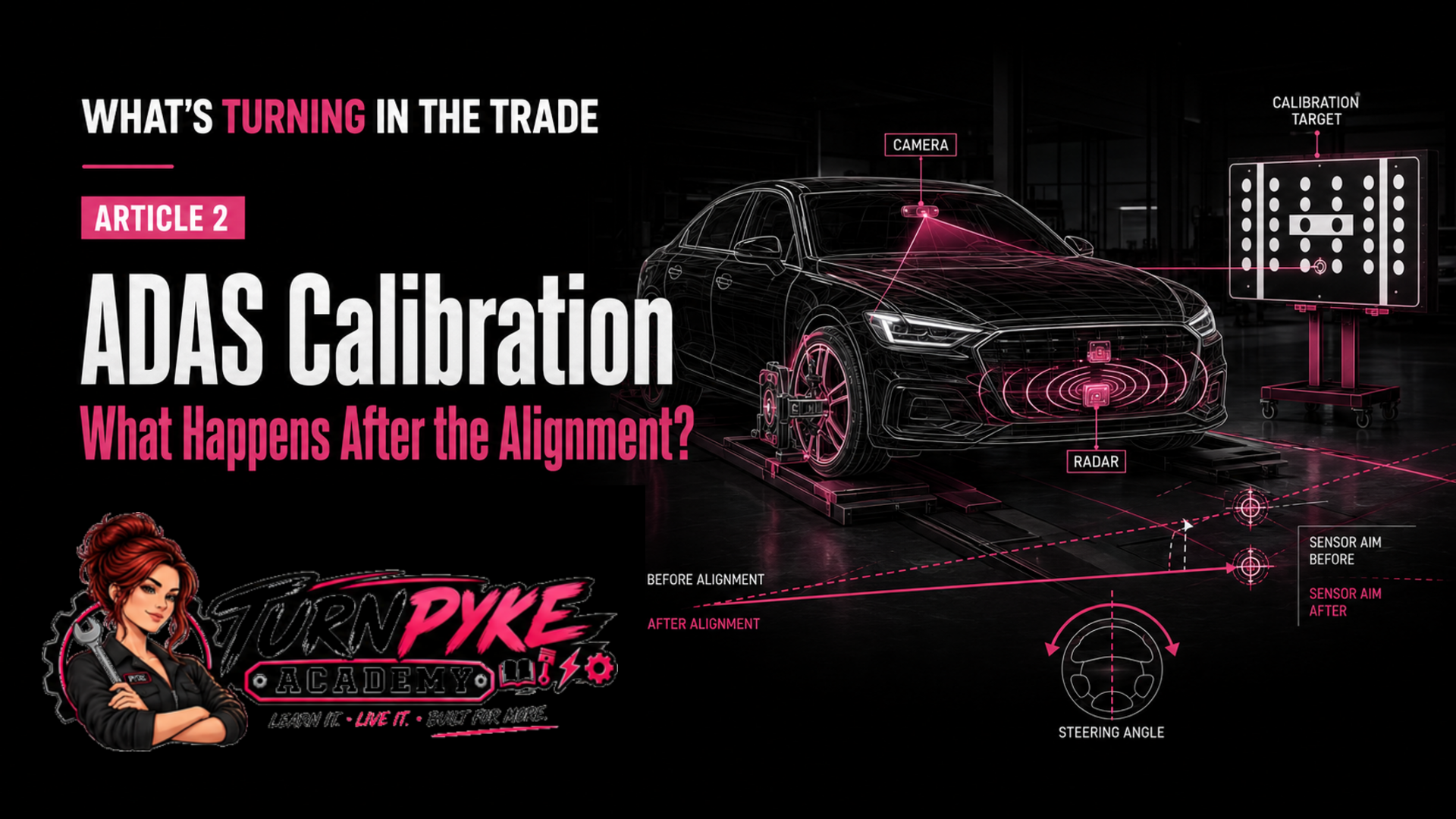
Once upon a time, you performed an alignment, got all the little numbers into the green boxes, printed the sheet and proudly sent the vehicle on its way.
Beautiful. Simple. Everybody went home.
Then automotive engineers apparently looked at this peaceful arrangement and thought: “You know what this needs? Cameras.”
And radar. And steering angle sensors. And calibration targets. And scan tools. And approximately seventeen pages of service information explaining why moving something three millimetres has ruined everybody's afternoon.
Welcome to ADAS.
The good news is that it isn't nearly as mysterious as it sounds.
1. What happened?
Vehicles increasingly use Advanced Driver Assistance Systems, better known as ADAS, to help the driver recognize hazards and control the vehicle.
- Adaptive cruise control
- Automatic emergency braking
- Forward collision warning
- Lane departure warning
- Lane keeping assistance
- Blind spot monitoring
- Rear cross traffic alert
- Traffic sign recognition
- Parking assistance
To make these systems work, the vehicle needs to know what is happening around it. Manufacturers use cameras, radar sensors, ultrasonic sensors, wheel speed information, steering angle information, and yaw and acceleration information.
The catch is that some of those systems need to know their exact relationship to the vehicle and the road. If that relationship changes because of a repair, component replacement, collision, ride height change or another manufacturer specified event, the system may require calibration.
Wheel alignment establishes where the wheels are pointing and, importantly, the direction the vehicle actually travels. ADAS sensors may use that vehicle geometry as part of determining where they should be looking.
An alignment does not automatically mean “calibrate everything.”
But it also doesn't mean: The alignment is green. We're done here. Nobody make eye contact with the radar.
Check the manufacturer's service information.
I know. Absolute chaos.
2. How does it work?
Let's start with the easiest way to understand ADAS calibration.
Imagine mounting a flashlight perfectly straight on the front of a vehicle. If the flashlight is actually pointed slightly to the left, the bulb still works. Power is good. Ground is good. The flashlight turns on. There are no warning lights. But the light is not pointing where the vehicle is going.
An ADAS sensor can have essentially the same problem. A camera or radar sensor may operate electrically while its aim is incorrect.
That's why calibration isn't simply checking whether the component works. It's teaching or confirming where that component is positioned relative to the vehicle.
Alignment matters because the vehicle has a direction of travel.
Your steering wheel being straight doesn't necessarily mean the vehicle's geometric relationship is correct. One important measurement is thrust angle.
Thrust angle represents the direction the rear wheels are effectively pushing the vehicle relative to its geometric centreline. If that angle is incorrect, the vehicle may travel slightly differently from where the body appears to be pointing.
Before teaching the camera where straight ahead is, we should probably make sure the vehicle knows too. Seems fair.
So what exactly is calibration?
There are two common approaches.
Static calibration
Static calibration happens while the vehicle is stationary. The technician may position special targets or reflectors at very precise locations around or ahead of the vehicle.
And when I say precise, I mean this is not the time for: “Meh. That's about three metres.”
- Distance from the vehicle
- Target height
- Target position
- Floor level
- Steering position
- Tire pressure
- Vehicle loading
- Fuel level
- Ride height
- Lighting conditions
- Clear space surrounding the vehicle
The scan tool then initiates the calibration while the sensor uses the target as a known reference. Think of it as telling the sensor: “This is exactly where straight ahead is. Please remember this and don’t embarrass us.”
Dynamic calibration
Dynamic calibration takes place while driving. The technician initiates the procedure with a scan tool and then drives the vehicle under manufacturer specified conditions.
- Specific vehicle speeds
- Clearly visible lane markings
- Certain road types
- Specific distances
- Suitable weather
- Adequate lighting
- Enough surrounding objects or traffic for the system to identify
A dynamic calibration is not simply a test drive. Driving around the block while holding a coffee and saying “No warning lights. She’s good.” is not dynamic calibration. Nice try, though.
Some vehicles may use both
One manufacturer may require static calibration. Another dynamic calibration. Another static followed by dynamic. Another may say no calibration after that repair at all.
Golden ADAS rule: Never assume. Look it up.
3. Why should technicians care?
Because ADAS changes what counts as a complete repair.
Imagine you replace a suspension component, torque everything correctly, perform the alignment and every specification is beautiful. But the repair procedure requires an ADAS calibration afterward and nobody performs it. Mechanically, you may have repaired the suspension perfectly. But the entire repair is not finished yet.
A mechanical repair can affect an electronic system
- Wheel alignment
- Suspension repairs
- Ride height changes
- Windshield replacement
- Camera replacement
- Radar replacement
- Bumper removal or replacement
- Grille replacement
- Structural repairs
- Steering repairs
- Steering angle sensor procedures
- Certain wheel or tire changes
What else did this repair disturb?
That question is going to save you a lot of grief during your career.
Calibration can require serious shop space and tooling
- A large level floor area
- Precise measuring equipment
- Manufacturer specific targets
- Target stands
- Scan tool capabilities
- Suitable lighting
- Controlled vehicle conditions
ADAS calibration isn't always something you squeeze between the tire machine and Dave's half disassembled project truck that apparently hasn't moved since 2019.
And yes, safety matters
These sensors can contribute information to systems capable of influencing braking, steering assistance, vehicle speed and collision warnings.
A misaligned sensor may not necessarily behave like a completely failed sensor. It may still communicate and may not provide an obvious warning. Which is why following the calibration procedure matters.
4. What should an apprentice remember?
Alignment and ADAS calibration are related, but they are not the same procedure.
Alignment establishes vehicle geometry. Calibration establishes or confirms how an ADAS sensor is positioned relative to that geometry.
Never assume calibration is required after every alignment. Also never assume it is not required. Check the OEM procedure for the exact vehicle, system and repair performed.
Not: “We usually do it this way.” Not: “The last Honda didn’t need it.” Not even: “The scan tool didn’t have any codes.” Find the service information. Determine what the manufacturer requires. Perform the procedure. Verify the repair.
Congratulations. You are diagnosing instead of participating in automotive themed guessing games.
5. The C of Q Connection 🔧
- Camber
- Caster
- Toe
- Thrust angle
- Steering angle
- Ride height
- Tire pressure
- Wheel and tire size
- Sensors and inputs
- Module communication
- Scan tool operation
- Relearn procedures
- Initialization
- Calibration
- Manufacturer specifications
A C of Q question may not ask you to physically arrange calibration targets across a shop floor. But it can test the reasoning behind the procedure.
Do not try to electronically compensate for a mechanical problem. If the alignment is wrong, fix the alignment. If ride height is wrong, determine why. If tire pressures are incorrect, correct them. Then calibrate according to the manufacturer’s procedure.
The fancy technology still depends on boring old fundamentals behaving themselves. Funny how often automotive diagnosis comes back to that.
6. Sources
Honda/Acura: Aiming Driving Support Systems
Explains the relationship between wheel alignment, structural alignment and camera/radar aiming, including when aiming is and is not required following repairs.
https://techinfo.honda.com/RJANISIS/pubs/web/docs/ASL-H-1-21-E-final.pdf
Honda: Inspection, Calibration and Aiming Requirements
Repair guidance covering safety and driver assistance systems that can require inspection, calibration or aiming after collision and body repairs.
https://techinfo.honda.com/rjanisis/pubs/web/ASP04485.pdf
Toyota: Driving Support Systems
Identifies circumstances in which radar and front camera recalibration may be required.
I-CAR: ADAS Calibrations After Wheel Alignment
Examines why alignment can affect ADAS and how requirements vary between manufacturers.
7. Next Step 🔧
DAILY TORQUE 🔧
A vehicle has just received suspension repairs and a four wheel alignment. The steering wheel is centred and all alignment measurements are within specification. The vehicle is equipped with a forward facing ADAS camera. What should the technician do NEXT?
A. Perform a camera calibration on every vehicle after an alignment
B. Disconnect the battery to reset the camera’s learned position
C. Check the manufacturer service information for calibration requirements
D. Road test the vehicle and calibrate only if a warning light appears
Correct Answer: C: Check the manufacturer service information for calibration requirements
ADAS calibration requirements are vehicle and manufacturer specific. An alignment alone does not universally require camera or radar calibration, and the absence of a warning light does not prove that calibration is not required.
A is incorrect because calibration is not universally required after every alignment.
B is incorrect because disconnecting the battery does not replace an OEM calibration procedure.
D is incorrect because a warning light is not the deciding factor for calibration requirements.
Apprentice takeaway: Check the service information for the exact vehicle and repair. Not Dave. Not TikTok. The service information.
At TurnPyke Academy, we do not just memorize which answer is correct. We work through why it is correct so you can recognize the same principle when the exam changes the wording or a completely different vehicle rolls into your bay.
Knowledge. Confidence. Drive.