
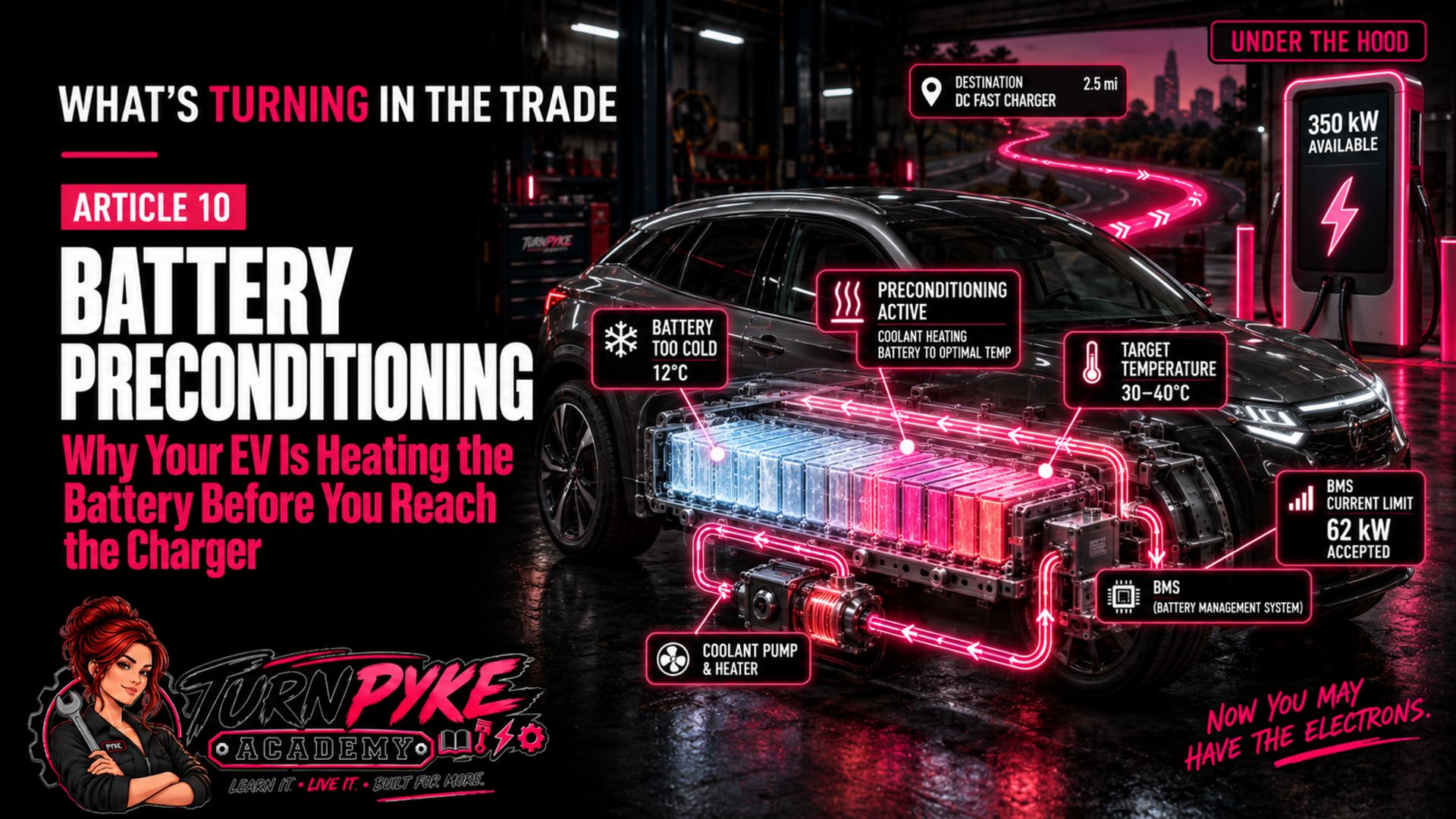
You put a fast charger into the navigation system.
You are still several kilometres away.
You have not plugged the vehicle in. You have not touched the charge port.
And somewhere underneath you, the car has quietly begun heating its own battery.
Which feels a little dramatic.
Until you remember that lithium ion batteries are basically the Goldilocks of automotive components.
Too cold? Angry.
Too hot? Also angry.
Just right?
NOW YOU MAY HAVE THE ELECTRONS.
Welcome to battery preconditioning.
And if you are a veteran technician who has survived steer by wire, brake by wire, software defined vehicles, ADAS calibration, CAN communication and EV heat pumps, and now the car is warming its own battery because it has apparently developed opinions about temperature, I completely understand why you are currently outside hugging a carburetor for emotional support.
Take your time. We will be here when you are ready.
1. What happened?
Electric vehicles can charge very quickly at a DC fast charger, but the battery has to be ready to accept that power.
A lithium ion battery does not charge equally well at every temperature. If the battery is too cold, charging performance can be limited. If it is too hot, the system may also reduce power to protect the battery.
Manufacturers use battery preconditioning to move the battery toward a useful temperature before fast charging begins.
Tesla explains that its vehicles can automatically precondition the battery when navigating to a Supercharger. Hyundai describes battery conditioning that can warm the high voltage battery in cold temperatures before fast charging. BMW also uses predictive thermal management to prepare the battery before rapid charging.
The vehicle is not being dramatic. Well, not only dramatic.
Temperature directly affects what the battery can safely and efficiently do.
2. How does it work?
Batteries are chemical devices
We spend so much time talking about volts, amps and kilowatts that it is easy to forget there is chemistry happening inside the battery cells.
Temperature affects those chemical reactions. When the battery is cold, reactions slow down, internal resistance can increase and the battery becomes less willing to accept a large charging current.
So if you arrive at a 350 kW charger with a battery approximately the temperature of a Canadian bus shelter in February, the charger may be capable of enormous power, but the battery may respond, "No thank you."
And the Battery Management System agrees.
Because unlike Canadians, batteries apparently have standards.
What does the Battery Management System do?
The BMS monitors and controls the high voltage battery. Depending on the design, it may monitor cell voltage, battery current, state of charge, battery temperatures, cell temperature differences, charging conditions and battery health.
The BMS uses that information to determine how much charging or discharging power is appropriate.
The charger does not simply throw everything it has at the battery. There is communication. The vehicle tells the charger what it is prepared to accept.
"Just dump 350 kilowatts into it and see what happens" is not currently recognized as an EV service procedure.
Why does a cold battery charge more slowly?
Inside a lithium ion battery, ions move between electrodes during charging and discharging. Cold temperatures make those processes more difficult, can increase internal resistance and reduce the amount of charging power the battery can safely accept.
The BMS may limit charging current.
You pull into a charger advertising 350 kW. You plug in. The car charges at 62 kW. Somebody immediately posts online, "THIS CHARGER IS BROKEN."
Maybe. Or maybe the vehicle rolled in with a freezing cold battery and the BMS is saying "Absolutely fucking not."
Diagnose before yelling at infrastructure. Good life advice generally.
How does preconditioning warm the battery?
That depends on the vehicle.
Manufacturers may use electric coolant heaters, heat pump energy, waste heat from the powertrain, battery heating elements, thermal management coolant circuits or motor and inverter heat.
Remember our EV heat pump article? This is why we refused to disappear down the battery thermal management rabbit hole there.
Hello, rabbit hole. We brought snacks.
Coolant based example
A battery pack may contain coolant passages or cooling plates. Coolant flows through the battery and the vehicle controls coolant temperature.
If the battery needs cooling, heat leaves the battery and enters the coolant. The vehicle may reject that heat through a radiator, a chiller connected to the refrigerant system or another thermal strategy.
If the battery needs warming, the vehicle can heat the coolant and transfer thermal energy into the battery.
When you enter a DC fast charger into navigation, the car may say, "Interesting. We are going to need the battery warm in 28 minutes," and start preparing.
Honestly, more planning than I do before leaving the house.
Why does navigation matter?
The vehicle needs to know you are going to fast charge.
If it knows the destination ahead of time, it has time to prepare the battery based on distance, battery temperature, ambient temperature, state of charge and driving conditions.
Remember when navigation just said "turn left in 300 metres"?
Those were innocent times.
Does preconditioning always mean heating?
No.
Battery preconditioning means preparing battery temperature. That may mean heating it or cooling it.
The goal is not HOT BATTERY GOOD. The goal is CORRECT BATTERY TEMPERATURE GOOD.
Goldilocks. We covered this.
What happens during fast charging?
Battery temperature continues to matter. Fast charging creates heat, so the vehicle may run coolant pumps, fans, refrigerant compressors, chillers and valves while it appears to be sitting peacefully in a parking space.
Underneath: FULL THERMAL MANAGEMENT RAVE.
The owner inside the coffee shop: "My car is making a weird noise."
Yes. It is currently managing several hundred volts and a small weather system. Let it cook.
Metaphorically.
Please do not actually let the battery cook. That is specifically what the cooling system is preventing.
3. Why should technicians care?
A customer may arrive saying, "My EV charges too slowly."
That complaint can involve battery temperature, state of charge, charger capability, battery thermal management, ambient temperature, battery condition, navigation preconditioning, coolant system operation, pumps, valves, software strategy, temperature sensors, heat pump operation or electric coolant heaters.
Before condemning something, understand the conditions.
Charging speed is not constant
"Up to 350 kW" does not mean 350 kW constantly.
Fast charging follows a charging curve. Power varies with state of charge and thermal conditions.
If someone says, "It was only charging at 70 kW," ask: at what state of charge, what battery temperature, what ambient temperature, which charger, was preconditioning active, and did the vehicle command reduced charging?
A number without conditions is not a diagnosis.
Temperature sensor faults can affect charging
If one battery temperature sensor falsely reports extremely cold, the BMS may limit charging, request heating, set a fault or change thermal management strategy.
The complaint may be slow fast charging, but the root cause may be bad information, not a bad battery.
Do multiple temperature sensors agree? Does the reported temperature make sense? Does it match actual conditions?
Coolant problems become charging problems
If a battery coolant pump does not operate, the vehicle may still drive but may not be able to control battery temperature during fast charging. The BMS may reduce charging power to protect the pack.
Customer complaint: slow charging.
Root cause: coolant circulation problem.
Welcome to EV diagnosis, where HVAC, electrical and cooling systems have formed an alliance specifically to ruin your diagnostic flowchart.
Air in the coolant circuit can matter too
Everybody who thought EVs would eliminate cooling system headaches: disappointing news.
Battery thermal management can still have leaks, air pockets, poor circulation, valve faults, pump faults, incorrect coolant and improper bleeding.
One day an apprentice will be standing beside a high voltage battery bleeding a thermal management circuit while an older technician walks past holding a carburetor and whispering, "We used to adjust idle screws."
Times change.
Software matters again
Preconditioning is not simply heater ON. Software decides when heating begins, target temperature, how much energy to spend, whether waste heat is available, whether cabin comfort gets priority and how charging power should be limited.
"Did you check for software updates?" can be a legitimate part of a battery temperature diagnosis.
Every carburetor in the country just got hugged tighter.
High voltage safety matters
Battery thermal management can place technicians near high voltage batteries, heaters, compressors, orange cables and electrically driven components.
PPE matters. Isolation matters. Verification matters. Training matters.
You can freestyle lunch. You can freestyle your playlist.
We do not freestyle high voltage.
4. What should an apprentice remember?
Battery preconditioning prepares the high voltage battery for the conditions it is about to experience.
For fast charging, that means moving battery temperature toward a range where the battery can safely accept higher charging power.
Cold battery? The system may warm it.
Hot battery? The system may cool it.
The goal is correct temperature, not maximum temperature.
The charging station does not decide charging power by itself. The vehicle and charger communicate, and the BMS determines what the battery can safely accept.
So if charging power is low, ask WHY the vehicle is limiting it.
Think in systems: battery temperature, state of charge, thermal management, charger capability, sensors, coolant flow, software and battery condition.
That is much better than "must need a battery."
Please.
That thing costs more than my car.
Let's test it first.
5. The C of Q Connection
Battery preconditioning connects directly to battery fundamentals, temperature effects, resistance, current, voltage, temperature sensors, coolant pumps, coolant flow, HVAC refrigeration, heat transfer, electric motors, high voltage safety, scan tool data, module inputs and outputs and diagnostic strategy.
Especially important: sensor input affects control output.
If the BMS believes the battery is too cold, it may request heating and limit charging power. If the input is wrong, several system behaviours may be wrong.
If one battery temperature sensor reads far colder than every other sensor after the vehicle has been parked indoors overnight, investigate that sensor and its circuit before condemning the entire battery or charger.
6. Sources
Tesla, Supercharging and Battery Preconditioning:
https://www.tesla.com/ownersmanual/model3/en_us/GUID-76995CEC-6402-4BFF-99FA-CEFA36E64A19.html
Hyundai, Battery Conditioning:
https://www.hyundai.com/worldwide/en/eco/ioniq5/battery-conditioning
BMW Group, High Voltage Battery Preconditioning:
https://www.bmwgroup.com/en/news/general/2023/battery-preconditioning.html
U.S. Department of Energy, Electric Vehicle Charging:
https://www.energy.gov/energysaver/electric-vehicle-charging
OEM service information wins because thermal systems vary enormously by vehicle.
Learn the principle, then look up the vehicle. That is the TurnPyke way.
7. Next Step
DAILY TORQUE
A battery electric vehicle arrives at a DC fast charger in very cold weather. The high voltage battery is well below its preferred charging temperature.
Why might the vehicle limit charging power?
A. The battery cannot produce voltage at low temperatures
B. Cold battery conditions can increase internal resistance and limit safe charging current
C. The electric motor must reach operating temperature before charging
D. The vehicle must warm the passenger compartment before accepting DC power
Correct Answer: B. Cold battery conditions can increase internal resistance and limit safe charging current.
A cold lithium ion battery may not safely accept the same charging power it could under favourable thermal conditions. The BMS can limit current until battery temperature improves.
A is incorrect because the battery still produces voltage. It has not become a very expensive brick.
D is incorrect because the vehicle does not need to ensure the occupants are emotionally comfortable before allowing electrons into the battery. Although heated seats remain one of civilization's greatest achievements.
Apprentice Takeaway: Fast charging is not only about how much power the charger can provide. It is also about how much power the battery is prepared to accept.
And if you have now finished this ten article batch and feel like the automotive industry has spent the entire time saying:
"Remember that mechanical thing you understood?"
"Yeah."
"We made it electronic."
then congratulations. You have accurately identified the current direction of the trade.
We electronically control throttle, steering, braking, thermal management, charging, suspension, driver assistance and increasingly the vehicle's entire architecture.
Which is why somewhere outside the shop right now there is a veteran technician.
He has survived forty years of flat rate. Rebuilt transmissions. Set points with a feeler gauge. Adjusted carburetors by ear. Diagnosed vehicles before scan tools existed. Watched everything he knows slowly acquire a control module.
And after reading these ten articles, he is quietly hugging a carburetor for emotional support.
Do not disturb him. He has been through enough.
The good news? The technology keeps changing. The diagnostic thinking does not.
Inputs. Outputs. Power. Ground. Communication. Temperature. Pressure. Mechanical movement. Feedback.
Understand what the system is trying to do. Then prove which part is preventing it.
At TurnPyke Academy, we learn the why. Because once you understand the why, the new technology becomes a hell of a lot less scary and considerably more fun to diagnose.
Knowledge. Confidence. Drive.