Previously on What's Turning in the Trade:
We learned that CAN communication is essentially the vehicle's group chat.
Modules send messages. Other modules listen. Everybody shares information.
And occasionally one module stops talking and the scan report looks like the automotive equivalent of 47 MISSED CALLS.
We also established one of the greatest diagnostic truths to emerge from this blog:
ONE PROBLEM. TWELVE WITNESSES.
But that first CAN article was the theatrical release.
Nice. Approachable. Everybody went home understanding terminating resistors.
Today?
Director's Cut.
Extended runtime. Deleted scenes. More gateways. More networks. A small amount of Ethernet. And several opportunities to stare at a wiring diagram and whisper, "Who designed this?"
The answer is an engineer.
They are not available for comment.
1. What happened?
CAN networks got busier. A lot busier.
Modern vehicles may need to move data between powertrain modules, ADAS, battery management, electric drive systems, body electronics, infotainment, chassis systems, cameras, radar, diagnostics, connected services and increasingly powerful central computers.
Classical CAN is still enormously important, but the amount of data vehicles need to move has grown.
So the industry developed faster and higher capacity versions. One of the biggest is CAN FD, or Flexible Data Rate.
Classical CAN carries up to 8 data bytes in one frame. CAN FD can carry up to 64 bytes and can transmit the data portion of a message at a faster rate.
In apprentice language, the group chat got upgraded.
Instead of sending "Hey" then "Here" then "is" then "my" then "data" in five separate messages, CAN FD can send "HERE IS ALL MY DATA PLEASE STOP MAKING ME TEXT LIKE A TEENAGER IN 2007."
Efficiency.
2. How does it work?
Modern vehicles usually do not have one giant CAN network
This catches apprentices all the time.
You plug into the diagnostic connector and think, "I plugged into the car."
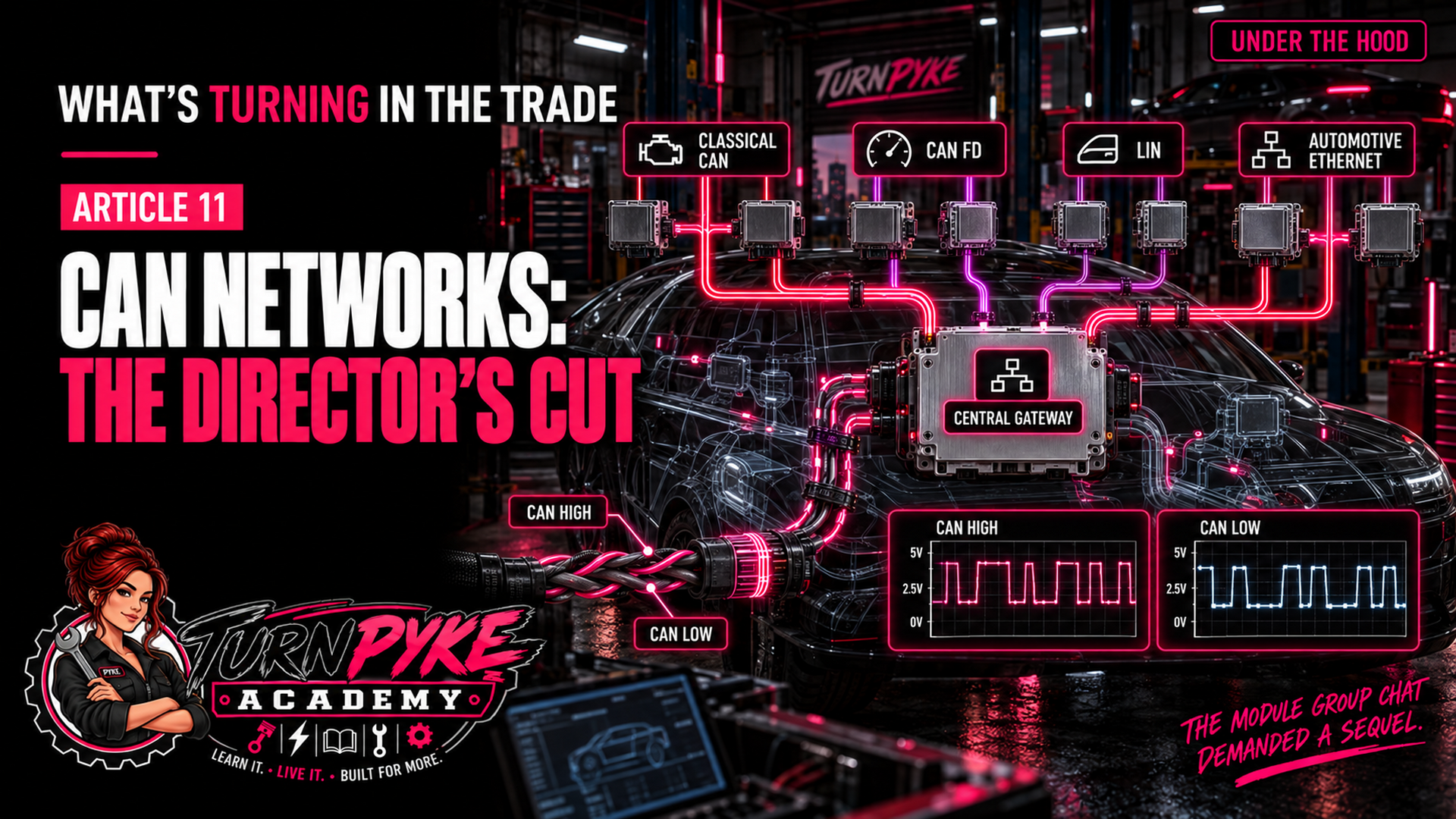
Technically yes. But inside that vehicle there may be powertrain CAN, chassis CAN, body CAN, ADAS networks, LIN networks, CAN FD, Automotive Ethernet and manufacturer specific variations.
Different networks may communicate through a gateway module.
What does a gateway do?
Think of the gateway like the receptionist at a very large dealership.
Everybody works in the same building, but that does not mean you can walk directly into every department. Requests may have to travel through the appropriate path.
A gateway connects vehicle networks, routes information between them and can act as an important diagnostic access point.
The engine module may live on one network. The body module on another. The cluster needs engine coolant temperature. The gateway receives that information from one network and routes it onto another.
Basically, the gateway forwards gossip between departments.
Professionally.
Why use multiple networks?
Not every system needs the same communication speed, cost or data volume.
A powertrain controller may need very fast information. A door module controlling a window switch does not need to transmit War and Peace every millisecond.
You do not need a six lane highway to deliver one pizza.
Although based on Ontario traffic planning, apparently we will try.
This is where LIN comes in
LIN stands for Local Interconnect Network. It is usually slower and simpler than CAN and can be used for local devices such as window motors, seat electronics, rain sensors, mirror controls, blower electronics and smart alternators depending on the vehicle.
A CAN connected module may act as the master for several LIN devices.
So a diagnostic path can become scan tool to gateway to CAN network to body module to LIN network to window motor.
And the customer complaint was "window does not work."
Amazing.
We built the automotive equivalent of corporate management. There are five levels of communication between you and the person actually doing the job.
Now let's talk CAN FD
CAN FD retains many CAN concepts: message identifiers, arbitration, dominant and recessive states and error detection.
But a CAN FD frame can use one speed during arbitration and then switch to a faster speed during the data portion.
The beginning essentially asks "WHO GETS TO TALK?" at the normal speed. Once one module wins arbitration, the data portion goes GO GO GO GO GO.
Annoyingly clever.
More data per message matters
Classical CAN: up to 8 data bytes.
CAN FD: up to 64 data bytes.
That means fewer separate frames may be needed to move larger amounts of information.
CAN FD is not just a future thing. It is already in the shop.
Surprise.
And now CAN XL exists because apparently we were not done
You thought CAN, then CAN FD, and surely everyone was satisfied.
No. Of course not.
Bosch also supports CAN XL, which can handle much larger payloads and higher data rates while retaining useful CAN principles.
Classical CAN: 8 bytes.
CAN FD: 64 bytes.
CAN XL: up to 2048 bytes.
CAN looked at its younger sibling and said, "You know what? I am tired of being the slow one."
Character development.
Automotive Ethernet
Somebody eventually asks, "Why don't we just use Ethernet like computers?"
Excellent question. Manufacturers increasingly do.
Automotive Ethernet is useful for high bandwidth systems such as cameras, ADAS, infotainment, central computing, software updates and high speed diagnostics.
A modern vehicle can contain CAN, CAN FD, LIN and Ethernet, potentially several versions of each, with a gateway connecting them.
Meanwhile the apprentice has been handed U0073 Control Module Communication Bus Off.
Have fun.
What does topology mean?
Network topology simply means how everything is physically connected.
Some networks resemble a bus. Others use branches, stars, gateways, subnetworks or several interconnected buses.
Topology helps you understand what a fault should affect.
If five modules stop communicating and all five live on one branch, maybe they did not all spontaneously die. Maybe the problem is the shared branch, connector, splice, gateway, power or ground.
ONE PROBLEM. TWELVE WITNESSES.
Director's Cut edition.
3. Why should technicians care?
Network architecture changes how you interpret symptoms.
If your scan tool can communicate with engine, transmission, ABS and airbag but not radio, HVAC, door modules or seat module, ask what the missing modules share. Maybe they all live on the same body network.
Now ask whether the gateway can see that network, whether it has power, whether it is shorted or open, whether the modules share a power or ground, and whether you can communicate directly elsewhere.
Chaos becomes structure.
A gateway problem can make healthy modules disappear
If the gateway cannot communicate with one network, your scan tool may report an entire group of modules missing even if those modules are perfectly healthy.
The receptionist stopped forwarding messages. Accounting did not spontaneously evaporate.
Secure gateways add another layer
Modern gateways can also control diagnostic access through authentication, firewalls and cybersecurity functions.
Sometimes your scan tool can read information but not perform active tests, programming or security sensitive functions until authentication occurs.
That is not necessarily a network failure. The vehicle may simply be asking, "Who are you and why are you touching my brakes?"
Reasonable.
Resistance testing gets more complicated
Our beautiful approximately 60 ohm rule is still useful on many high speed CAN networks, but not every network is Classical CAN, not every connector gives direct access to the complete bus, and not every design uses the same termination strategy.
Before announcing "IT'S NOT 60 OHMS. NETWORK DEAD," check the wiring diagram, topology, test location and manufacturer procedure.
Everybody together: READ THE SERVICE INFORMATION.
Beautiful. Our national anthem remains undefeated.
Oscilloscopes become even more useful
As network speeds increase, signal quality matters more. A DVOM may tell you voltage or resistance exists. A scope can show signal shape, noise, reflections, intermittent faults, voltage levels and timing problems.
Eventually somebody will say "get the scope," and the meter you loved five minutes ago will feel like a Fisher Price toy.
Do not panic.
We are absolutely writing Oscilloscopes Without the Existential Crisis later.
Scope instructors have been allowed to terrify apprentices for too long.
Wiring repairs matter enormously
Faster networks can be more sensitive to wire type, twist rate, length, routing, splice location, shielding and connector design.
This is not the circuit where we say, "I had some red 16 gauge left in the toolbox."
Put it down.
Network wiring is not your arts and crafts hour.
4. What should an apprentice remember?
Modern vehicles can contain several separate networks. Do not assume every module lives on the same CAN bus.
Gateways connect networks and route messages and diagnostics between them.
CAN FD is an evolution of Classical CAN that can carry more information and transmit the data phase faster.
LIN is commonly used for simpler local devices.
Ethernet is becoming important for very high bandwidth systems.
Most importantly, look for patterns.
If one module disappears, investigate the module.
If an entire network disappears, investigate what that network shares.
If several modules across multiple networks disappear, start looking higher up: gateway, power, ground, system voltage and architecture.
The number of witnesses tells you something about the crime scene.
5. The C of Q Connection
For 310S, deep CAN FD frame details matter less than network diagnostic principles.
Focus on network communication, module power and grounds, twisted pair wiring, termination, communication DTCs, gateway modules, topology, open circuits, short circuits, voltage testing, resistance testing, scan tool communication and diagnostic order.
If the scan tool communicates with powertrain and chassis modules but cannot communicate with any module on the body network, investigate the body network and gateway connection before replacing every body module.
If a LIN device fails while the CAN connected master module communicates normally, diagnose the LIN circuit, local device, power, ground and master communication with that device rather than condemning the entire CAN network.
Diagnose the network the failed device actually lives on.
That sentence can save enormous amounts of nonsense.
6. Sources
CAN in Automation, CAN FD: The Basic Idea:
https://can-cia.org/can-knowledge/can-fd-the-basic-idea
CAN in Automation, CAN Community News 2026:
https://www.can-cia.org/services/publications/can-community-news/ccn-2026-no-8
Bosch, CAN Protocols:
https://www.bosch-semiconductors.com/products/ip-modules/can-protocols/
Bosch, CAN FD Protocol:
https://www.bosch-semiconductors.com/products/ip-modules/can-protocols/can-fd/
Bosch Mobility, Central Gateway:
https://www.bosch-mobility.com/en/solutions/vehicle-computer/central-gateway/
OEM service information wins because exact network architecture varies dramatically between vehicles.
Do not walk up to a 2028 vehicle with a multimeter and say, "I have seen the Director's Cut. I fear nothing."
You should fear something.
Healthy respect keeps meter fuses alive.
7. Next Step
DAILY TORQUE
A technician can communicate with all powertrain and chassis modules, but every module on a separate body network is unavailable on the scan tool.
Which area should the technician investigate FIRST?
A. Each body module individually for simultaneous internal failure
B. The shared body network, gateway connection and related circuits
C. Engine control module programming
D. Battery temperature sensor calibration
Correct Answer: B. The shared body network, gateway connection and related circuits.
Multiple modules on one network have disappeared together. That pattern matters.
A requires us to believe several unrelated modules all died simultaneously. Technically possible. So is being attacked by three geese while changing a tire. We still investigate the more reasonable explanation first.
C involves a module already communicating normally. Leave him alone. He has done nothing.
D is the EV battery attempting to force its way into another article because apparently ten articles of attention were not enough. You had your moment, Goldilocks.
Apprentice Takeaway: When an entire group goes missing, investigate what the group shares.
And if CAN communication now feels more complicated than it did before reading this article, technically yes. Sorry.
But complicated is not random.
A network diagram may look like someone dropped a bowl of spaghetti onto Microsoft Paint, but the electrons still need a path.
Find the relationship. Find the shared fault. Find one problem, twelve witnesses.
Director's Cut.
Knowledge. Confidence. Drive.