
Alright.
Everybody who survived the last article about engineers removing the permanent mechanical connection between the steering wheel and the road wheels: I have unfortunate news.
They have come for the brake hydraulics.
For more than a century, technicians have relied on a beautifully understandable idea. You press the brake pedal. Hydraulic pressure travels through brake fluid. That pressure applies the brakes. Pascal's law does its thing. Vehicle stops. We all go home.
Apparently that arrangement was becoming a little too peaceful.
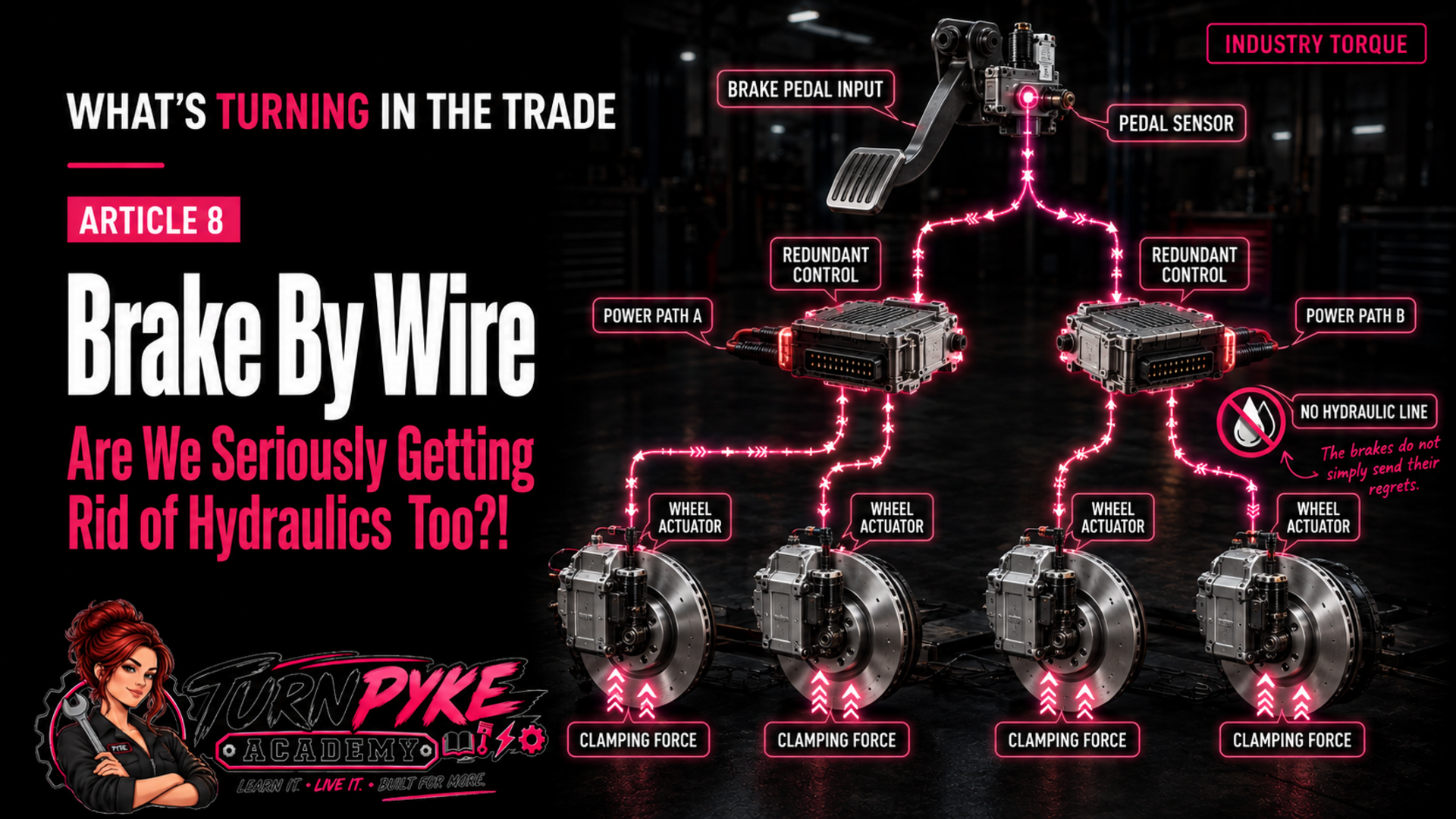
Automotive suppliers are now developing electromechanical brake systems where electrical signals travel from the brake pedal to individual electric actuators that physically apply the brakes.
Potentially no conventional master cylinder generating service brake pressure, no hydraulic lines running to the wheel brakes, and no brake fluid transmitting the driver's braking force.
Just sensors, computers, electric motors and software responsible for one of the most safety critical functions on the vehicle.
I'll give the old school technicians a minute.
Everybody good?
No?
Excellent. Let's continue.
1. What happened?
Brake by wire technology has been developing for years, and some forms are already used in modern vehicles.
But brake by wire does not automatically mean hydraulic brakes disappear.
Some systems still use hydraulic pressure. The driver's pedal movement is sensed electronically, the system decides how much braking is required, and an electrically controlled hydraulic unit generates pressure.
Then there is electromechanical braking, or EMB.
In a fully electromechanical brake system, electric motors at or near the wheels generate the clamping force required to apply the friction brakes directly.
ZF describes a fully electric dry brake by wire system that can eliminate brake fluid from service brake actuation. Nexteer announced in April 2026 that its electromechanical brake system had completed development and validation and was market ready for mass production. ZF has also announced a major production contract involving electromechanical braking technology.
So yes. The hydraulic service brake system apprentices have spent generations learning may eventually become optional on some vehicles.
Somewhere, Pascal just threw his textbook across the room.
2. How does it work?
Conventional hydraulic braking
You press the brake pedal. The pedal acts on a master cylinder. The master cylinder converts mechanical force into hydraulic pressure. That pressure travels through brake fluid to calipers or wheel cylinders. Pistons move. Friction material contacts the rotor or drum. Vehicle slows.
Beautiful. Simple. Also responsible for generations of apprentices having a deeply spiritual experience while trying to remove one tiny air bubble from a brake line.
Brake by wire changes the pedal relationship
In a brake by wire system, pressing the pedal may not directly create all the pressure used to stop the vehicle. Sensors measure pedal travel, pedal force and driver braking request. A control unit then decides how much braking force is required.
That matters especially on hybrids and EVs because the vehicle may have regenerative braking and friction braking available at the same time. The system blends them so the driver does not feel like somebody is repeatedly grabbing and releasing the brakes.
Electromechanical brakes take hydraulics out of the equation
The chain becomes driver presses pedal, pedal sensors measure the request, brake controller calculates required force, electrical command travels to the wheel actuator, electric motor generates clamping force, pads squeeze the rotor and the vehicle slows.
There is no need for hydraulic pressure to travel from the front of the vehicle to that wheel.
We taught electricity how to operate the caliper.
What could possibly make technicians nervous about that?
How does an electric motor make enough brake force?
An electric motor produces rotational force, but brake pads need linear clamping force. The actuator uses mechanical reduction, such as gears and screw mechanisms, to convert rotation into a large mechanical clamping force.
We already use electric motors in parking brakes, throttles, HVAC doors, power steering and turbo actuators.
Electromechanical brakes simply take that idea and apply it to STOPPING THE ENTIRE VEHICLE.
No pressure.
Literally.
What does the brake pedal feel like?
If the pedal no longer directly generates conventional hydraulic pressure, what gives the driver pedal feel?
The system has to create it.
Pedal simulators or feedback mechanisms reproduce the resistance and travel the driver expects.
After electronically recreating steering feel, engineers apparently looked downward and thought, "Feet next."
I admire the commitment.
Why bother?
Electronic braking can react quickly and integrate precisely with regenerative braking, stability control, automated driving and individual wheel control.
If each wheel has an independently controlled actuator, the vehicle can precisely control braking force at each corner.
Instead of thinking only "brake system," we start thinking "vehicle motion control system."
The computers have formed a committee.
God help us.
3. Why should technicians care?
Traditional brake diagnosis gives us low fluid, leaks, air, master cylinders, hoses, sticking calipers, boosters and mechanical binding.
Electromechanical braking adds electric actuators, position sensors, force sensors, pedal sensors, control modules, communication networks, power supplies, grounds, software, calibration and redundant circuits.
A customer says, "The left rear brake is not applying properly."
Traditional brain: caliper?
Electromechanical brake brain: is the actuator being commanded, does it have power, ground and communication, does actual position match commanded position, is there mechanical binding, and is feedback correct?
Same complaint. Completely different diagnostic tree.
Scan data matters
Technicians may compare brake pedal request, commanded brake force, actual actuator position and measured braking force or feedback.
Input. Decision. Command. Output. Feedback.
Look at us. We dragged another futuristic system back into basic diagnostic logic.
Power and ground are back AGAIN
Apparently I will continue writing this paragraph until the sun explodes.
Electromechanical brakes use electric motors. Electric motors need electrical energy. Modules need electrical energy. Sensors need electrical energy.
We can remove hydraulic lines, master cylinders and brake fluid. We cannot remove the laws of electricity. They have excellent job security.
Brake service changes
Depending on the system, pad replacement may involve scan tool service modes, actuator retraction, initialization, calibration, pad replacement routines and manufacturer specific procedures.
Do not force electrically controlled brake components backward because "that is how I have always done brakes."
Electronic parking brakes already taught us this lesson. Some people apparently required a sequel.
What happens if the electrical system fails?
No, the brakes do not simply send their regrets.
Safety critical by wire systems require redundancy and fault tolerant design. Different suppliers use different strategies including redundant electrical supplies, sensors, communication paths, backup control and independent wheel actuators.
Exact answer? Read the OEM information.
Our national anthem again. Everybody stand.
Maintenance may change
If service brake actuation contains no hydraulic fluid, there is no conventional brake fluid replacement or bleeding for that portion of the system.
Somewhere in the future, an apprentice will ask "How do I bleed the brakes?" and the answer may genuinely be "You don't."
Automotive instructors will stare into the distance for three seconds, then assign a wiring diagram. Balance restored.
4. What should an apprentice remember?
Brake by wire and electromechanical braking are not automatically the same thing.
Brake by wire means the driver's braking request is electronically transmitted or controlled. Braking force may still be created hydraulically, or it may be created electromechanically.
A fully electromechanical brake uses an electric actuator at the wheel to generate friction brake clamping force directly.
Stop thinking only, "Where is my hydraulic pressure?" Ask, "What braking force is being requested, and what system is supposed to create it?"
Remember the chain: driver input, controller decision, command, output, feedback.
5. The C of Q Connection
Do not throw away your brake chapter.
Pascal's law still matters because hydraulic brakes will remain in the fleet for a very long time.
Understand hydraulic pressure, master cylinders, boosters, calipers, wheel cylinders, brake fluid, bleeding, disc and drum brakes, friction, ABS, traction control and stability control.
Newer systems add pedal sensors, pressure sensors, electric actuators, motors, module inputs and outputs, networks, regenerative braking, brake blending, power and ground diagnosis, service modes and calibration.
If a controller requests braking at one wheel but the commanded braking force does not occur, move your diagnosis toward the wheel brake actuator and related circuits. Input is good. Command exists. Output is missing.
That same reasoning worked for steer by wire. Learning principles beats memorizing forty thousand systems individually.
6. Sources
Nexteer Automotive, Market Ready Electromechanical Braking at Auto China 2026:
Nexteer Automotive, Braking in the Software Defined Era:
ZF, Brake By Wire Portfolio:
https://press.zf.com/press/en/releases/release_89558.html
ZF, Electromechanical Brake Production Contract:
https://press.zf.com/press/en/releases/release_80320.html
Continental, Future Brake System:
https://www.continental.com/en/press/press-releases/future-brake-system/
OEM service information wins. Different systems use different actuator types, redundancy, hydraulic backup arrangements, service modes, calibration procedures and safety precautions.
Do not walk into the shop announcing "hydraulics are cancelled." They are not. Please locate the service manual before you frighten your foreman.
7. Next Step
DAILY TORQUE
A vehicle equipped with a fully electromechanical brake system receives the driver's brake pedal request correctly. Scan data shows the controller is commanding the left front brake actuator, but actual actuator movement does not occur.
Which area should the technician investigate NEXT?
A. Left front brake actuator, power supply and related circuits
B. Brake pedal position sensor replacement
C. Hydraulic master cylinder outlet pressure
D. Brake fluid condition and moisture content
Correct Answer: A. Left front brake actuator, power supply and related circuits.
The system already received the driver's request. The controller is issuing the command. The expected output is not happening.
B goes backward and replaces an input already proven good.
C assumes a fully electromechanical wheel depends on conventional master cylinder pressure.
Pascal has left the building.
D checks fluid in a service brake architecture that does not use brake fluid to generate wheel clamping force. That would be like checking engine oil because the radio stopped working. Please do not.
Apprentice Takeaway: Know what creates the force before you decide how to test it.
And if you are now staring at a conventional brake caliper thinking, "You know what? Maybe I did not appreciate you enough," understandable.
The industry's long term plan appears to be: remove all the cables, remove all the hydraulics, add seventeen computers, hand the technician a wiring diagram and say, "Anyway, good luck."
Rude. But manageable.
Knowledge. Confidence. Drive.