There was a time when the information you needed to repair a car was located in an exciting new place called the car.
Revolutionary.
You connected your scan tool. You checked the wiring diagram. You looked up specifications. You tested the system. You fixed the problem.
Modern vehicles have complicated that relationship considerably.
Today's vehicles can generate enormous amounts of information about system operation, faults, component health, battery condition, software, maintenance, location, driving information and connected services.
Some of that information can leave the vehicle through built in communication systems and travel to manufacturer servers.
Which creates an important question: if you own the car, who gets to control the information required to fix it?
Welcome to the Canadian conversation about Right to Repair.
And before anyone leaves because this sounds suspiciously like a government policy article, come back. I promise nobody is making you read 147 pages of legislation.
We are talking about whether technicians can actually access what they need to repair the vehicle sitting in front of them.
1. What happened?
Cars became connected. Really connected.
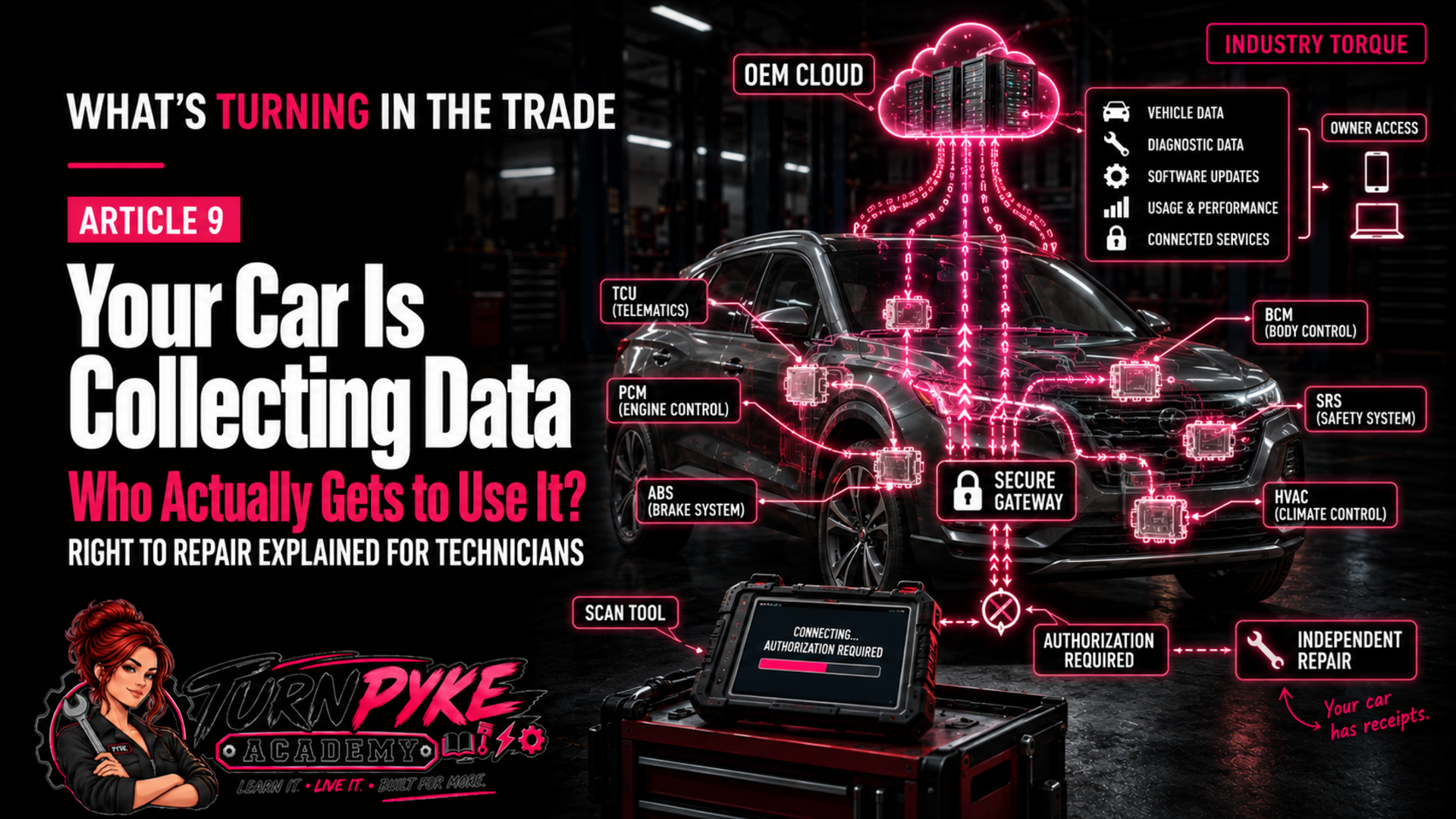
Modern vehicles can use cellular communication, cloud services and telematics to transmit information between the vehicle, manufacturer servers, apps and digital services.
AIA Canada says modern vehicles increasingly rely on software, sensors and connected systems, and proper diagnosis and repair can require access to detailed vehicle repair and maintenance information.
The traditional diagnostic connector is no longer necessarily the only doorway into the vehicle's information.
Some information may be stored in modules, available through an OEM diagnostic platform, protected behind a secure gateway, stored remotely, connected to manufacturer servers or restricted through authorization and subscription.
As vehicles become more software controlled, access to that information can determine whether a shop can complete a repair.
The modern question becomes: can I diagnose the problem, and can I access the system required to diagnose the problem?
Those should not be two different questions. And yet, here we are.
2. How does it work?
What is vehicle data?
Modern vehicles generate information relating to engine performance, battery health, charging, diagnostic trouble codes, component operation, maintenance, speed, temperatures, sensor readings, software status, system faults and ADAS operation.
Vehicle data is not one magical spreadsheet somewhere labelled CAR STUFF.xlsx. It is information distributed across an increasingly complicated digital ecosystem.
What are telematics?
Telematics is the vehicle's ability to collect information and communicate it remotely.
A vehicle may send diagnostic information, receive updates, report maintenance conditions, communicate with a phone app, provide remote functions or contact connected services.
Manufacturers can communicate with the vehicle without somebody physically plugging into the diagnostic connector.
Very useful. It also means the information no longer necessarily stays inside the vehicle.
Whoever controls the digital pathway can influence who can access that information.
Can independent shops access it?
Sometimes yes. Sometimes not easily.
Historically, much repair information could be obtained through service manuals, scan tools, databases, OEM subscriptions and the OBD connector.
As more information moves through connected systems and protected software environments, independent shops can encounter barriers accessing the same information.
Imagine the technician understands the fault, owns the tools, has the part and the customer wants that shop to perform the repair, but required software or data is inaccessible.
That is like giving somebody a locked toolbox and saying, "Technically all the tools are in there."
Very helpful.
What about secure gateways?
Before we declare "SECURITY BAD. OPEN EVERYTHING," no.
Connected vehicles need cybersecurity. Modern vehicles contain systems controlling steering, braking, powertrain, high voltage functions, locks and communication.
We do not want every computer with an internet connection invited into the ABS module.
Manufacturers use authentication, encryption, secure gateways, user permissions and protected programming functions.
The Right to Repair challenge is how to maintain cybersecurity while still allowing legitimate technicians authorized by the vehicle owner to perform diagnosis and repair.
We can want secure vehicles AND repairable vehicles.
Incredible. Two thoughts at once. Automotive has prepared us for this.
Didn't Canada already pass Right to Repair legislation?
Kind of.
Bill C 244 received Royal Assent on November 7, 2024. It amended the Copyright Act to allow technological protection measures to be bypassed in certain circumstances when the purpose is diagnosis, maintenance or repair.
Important step. But it does not automatically force manufacturers to provide every technician with every piece of repair data, software, tool or function required on equal terms.
A law saying "you may legally bypass a digital lock for legitimate repair" is not the same as "the manufacturer must provide every required tool, data stream and repair resource."
AIA Canada continues to advocate for automotive specific Right to Repair rules around timely access to vehicle repair data, software and tools.
Progress? Yes.
Problem completely solved? Nope.
Would have been suspiciously efficient for government policy anyway.
What do Canadian owners think?
AIA Canada research found that only 30 percent of surveyed drivers believed they currently owned the data produced by their vehicle, while 74 percent believed the vehicle owner should own it. A majority also supported standardized open access for independent repair providers and the right to choose where their vehicle is serviced.
Many drivers had never really thought about vehicle data ownership before.
Which makes sense. Nobody buys a car and thinks, "Gorgeous interior. Great fuel economy. Quick question: who legally controls my left rear wheel speed data?"
3. Why should technicians care?
Access to information is becoming part of the technician's toolbox.
For decades, technicians needed hand tools, scan tools, meters, scopes, special tools, training and service information.
Now add digital access.
A skilled technician can still be limited if programming, coding, secure functions, ADAS calibration, module replacement or online service functions require access the shop does not have.
The wrench still matters. Unfortunately, so does the login.
This affects dealership technicians too
Right to Repair is often framed as dealerships versus independent shops. That is too simplistic.
Technicians move between dealerships, independent shops, fleets, teaching, diagnostics and business ownership throughout their careers.
The broader question is whether qualified technicians can access what they need to safely repair modern vehicles.
When everything works, the digital infrastructure is invisible. You become very aware of it when the login server goes down at 2:17 PM and six unfinished vehicles stare at you from across the shop.
Rural communities can be affected even more
Canada is enormous. This will surprise absolutely nobody who has driven across Ontario and spent three hours looking at identical trees.
Not every community has a dealership for every manufacturer nearby. Restricted data access can turn a software problem into a time, cost and transportation problem.
And occasionally a "Well shit, how am I getting to work tomorrow?" problem.
Shops need to know what to invest in
Before spending serious money on training, ADAS equipment, EV tools, programming equipment and subscriptions, a shop wants to know whether it will actually be able to service those vehicles.
Access and education are connected.
Technicians also have a responsibility
Right to Repair does not mean unrestricted access to everything because freedom.
Vehicles contain personal information, security systems, safety critical electronics, software, immobilizer systems and connected accounts.
Technicians have responsibilities around privacy, cybersecurity, authorization and data handling.
The technician of the future is not only protecting the customer's vehicle and keys. We may also be protecting the customer's data.
4. What should an apprentice remember?
Being able to physically repair a vehicle and being able to digitally access what is required to repair it are becoming increasingly connected.
Modern technicians need reliable service information, diagnostic data, programming functions, calibration procedures, software and secure access.
Right to Repair does not mean removing cybersecurity. We want vehicles protected against unauthorized access while still allowing authorized owners and legitimate repairers reasonable service access.
Bill C 244 was important, but it did not settle every automotive data access issue in Canada.
The automotive industry has managed to turn "Can I fix my own car?" into a conversation involving copyright law.
Frankly impressive.
5. The C of Q Connection
You are unlikely to see a long policy essay on the 310S exam, but the technology underneath this conversation is very relevant.
Understand DTCs, scan tool operation, module communication, CAN networks, gateway modules, programming, initialization, calibration, service information, software controlled systems, cybersecurity principles and telematics.
Know when a replacement component requires configuration, programming, calibration or relearn.
If a replacement module communicates normally but OEM information says configuration is required before the system will operate, perform the specified configuration procedure.
This is not an invitation to become creative. Ignoring the giant instruction that says CONFIGURE MODULE AFTER REPLACEMENT is not diagnostic innovation.
6. Sources
Parliament of Canada, Bill C 244, Royal Assent November 7, 2024:
https://www.parl.ca/DocumentViewer/en/44-1/bill/C-244/royal-assent
AIA Canada, Right to Repair and Access to Repair Data, February 2026:
AIA Canada, Vehicle Data Ownership and the Right to Repair:
AIA Canada, Data, Diagnostics and Decision Making, March 2026:
AIA Canada, Future of Vehicle Data Access:
AIA Canada, The Missing Piece, April 2026:
7. Next Step
DAILY TORQUE
A technician replaces a vehicle control module. The new module communicates normally with the scan tool, but the related system remains inoperative. OEM service information states that replacement modules must be configured after installation.
What should the technician do NEXT?
A. Replace the module because it is not operating the system
B. Perform the manufacturer specified module configuration
C. Replace the CAN network terminating resistors
D. Disconnect every network module and reconnect them individually
Correct Answer: B. Perform the manufacturer specified module configuration.
The module is already communicating. The service information tells us what must happen next.
A fires another module out of the parts cannon. The parts department appreciates your enthusiasm. Your customer may not.
C introduces a CAN termination fault without any evidence one exists. CAN Networks: The Director's Cut will deal with your obsession later.
D turns a straightforward programming requirement into an afternoon of unnecessary suffering. Nobody requested that.
Apprentice Takeaway: A new module is not always a ready module.
This is fixing cars now: mechanical repair, electrical diagnosis, computer networking, cybersecurity, software, data access, government legislation and remembering fourteen different passwords.
Sometimes the hardest part is finding the broken wire. Sometimes it is understanding the data.
And apparently sometimes it is accepting the Terms and Conditions before the scan tool will let you continue.
What a time to be alive.
Knowledge. Confidence. Drive.