There is a special kind of automotive panic reserved for turning the ignition on and watching the instrument cluster illuminate like a Christmas tree.
ABS light.
Traction control light.
Power steering warning.
Check engine light.
ADAS warning.
Maybe the airbag light joins in because apparently everyone was invited.
You scan the vehicle and find U0100. U0121. U0140. Lost communication. Lost communication. More lost communication.
And suddenly the vehicle appears to have suffered six completely unrelated module failures at exactly 8:42 Tuesday morning.
Seems likely.
Or the modules are all connected to a communication network, and something has gone wrong with the conversation.
Welcome to CAN communication.
Or, as I prefer to think of it: the vehicle's extremely fast group chat.
Everybody is constantly talking. Everybody is listening. Some messages are more important than others. And when one participant completely loses its mind, somehow everybody ends up involved.
1. What happened?
Modern vehicles contain a lot of electronic control modules: engine, transmission, ABS, airbag, power steering, body control, HVAC, instrument cluster, ADAS, door modules, seat modules, battery management and plenty more.
These modules need information from each other. The ABS module may calculate wheel speed information, but wheel speed can also be useful to the engine controller, transmission controller, power steering, instrument cluster and driver assistance systems.
Instead of installing a separate wire from every sensor to every module that needs its information, manufacturers use communication networks. One of the most important is the Controller Area Network, or CAN.
CAN was originally developed by Bosch for automotive applications and has since become one of the foundational communication technologies used throughout vehicles and many other industries.
On a CAN network, modules transmit information over shared communication lines. The message goes into the group chat, and every module on that network can hear it. One module says, "Vehicle speed is 82 km/h." The engine controller might care. The transmission controller might care. The radio probably does not. Hopefully.
The information only needs to be transmitted once. That reduces wiring and allows multiple systems to share information very quickly.
Which is fantastic. Until the group chat stops working. Then everybody apparently calls in sick.
2. How does it work?
We will start with a typical high speed CAN network. No binary mathematics exam. No hexadecimal seance. No oscilloscope screen that looks like the Matrix. Not yet.
CAN usually communicates over two wires
You will commonly see CAN High and CAN Low. These two wires carry signals that allow modules to determine whether the network is transmitting a dominant or recessive bit.
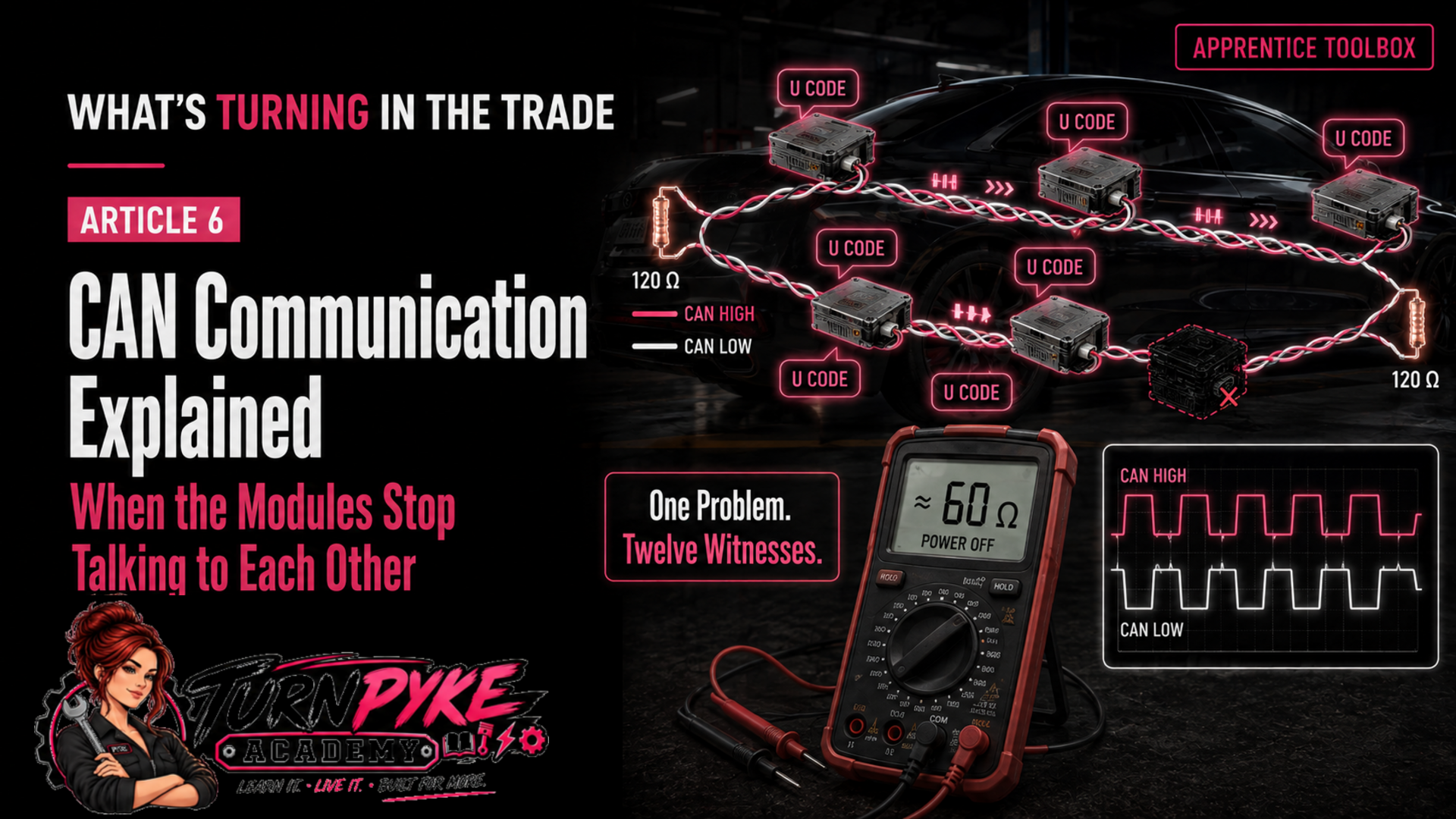
High speed CAN uses a differential voltage between CAN High and CAN Low. During the recessive state, both lines sit around the same voltage. During a dominant state, CAN High rises while CAN Low falls, creating a larger voltage difference.
Rather than asking only, "Is this wire 5 volts?" the CAN transceiver is largely interested in the voltage difference between the two wires.
That differential signalling makes CAN more resistant to electrical noise, which is useful because vehicles are not exactly peaceful electrical environments. We have ignition systems, motors, alternators, injectors, relays, solenoids, electric power steering and Carl using an impact gun approximately four millimetres from your head.
Why are the wires twisted together?
If you open a wiring harness and find two communication wires twisted around each other, that was not because somebody at the factory got bored.
Twisting helps both wires experience similar electrical interference. Because CAN communication depends on the difference between the two signals, interference affecting both similarly can be easier for the receiver to reject.
If you repair twisted network wiring, put it back the way the manufacturer specifies. Do not untwist twelve inches because "wire is wire." Somewhere an electrical instructor just developed an eye twitch.
Dominant and recessive bits
CAN has two logical states. A dominant bit represents logical 0. A recessive bit represents logical 1. If a dominant and recessive bit are transmitted at the same time, dominant wins.
That matters because CAN has a clever way of deciding who gets to talk when several modules begin transmitting at once.
Imagine the modules all start talking at once
Several modules want to send messages. They begin transmitting their message identifiers while also monitoring what is actually happening on the network.
If a module sends a recessive bit but detects a dominant bit instead, it knows somebody with a higher priority message is talking. It stops transmitting and waits. The higher priority message continues. This is arbitration.
It is essentially CAN saying, "Everybody calm down. ABS has something important to say."
Remarkably civilized. I have attended meetings that were less organized.
What are the terminating resistors doing?
Ah yes. The famous 60 ohms.
A typical high speed CAN bus uses a 120 ohm terminating resistor at each end of the network. Those two resistors are connected across CAN High and CAN Low. When the network is powered down and you measure across the complete network, the two 120 ohm resistors appear in parallel, producing approximately 60 ohms.
The terminating resistors help maintain signal quality and reduce signal reflections on the bus.
Think of yelling down a tunnel. Without proper termination, part of the signal can reflect back and interfere with communication. Except instead of "HELLO... hello... hello..." your network says "ERROR FRAME." Less charming.
Does 60 ohms always mean the network is good?
NO.
60 ohms does not prove the entire CAN network is healthy. It is one clue about the termination and the circuit being measured.
A network can still have intermittent opens, shorts, voltage problems, ground problems, damaged connectors, module faults or signal distortion.
If a network expected to have two 120 ohm terminating resistors measures about 120 ohms, one termination path may be missing. But check the wiring diagram and diagnostic procedure first. Manufacturers enjoy network architecture approximately as much as they enjoy hiding 10 mm fasteners.
How does CAN handle errors?
CAN has error detection built into the protocol. Modules monitor transmitted information and can recognize communication errors. A controller that detects certain errors can generate an error frame, and incorrect messages are discarded.
Controllers also keep track of repeated faults. A module with enough communication errors can eventually enter a bus off condition where it stops transmitting.
Translated into group chat:
Module: "Hey guys."
Network: "That message was corrupted."
Module: "Okay, I will try again."
Network: "Still wrong."
Module: "Again?"
Network: "No."
Module has been removed from the group.
Automotive engineering is beautiful.
3. Why should technicians care?
CAN failures can create symptoms that look completely unrelated. One communication problem can create ABS warnings, traction control warnings, steering warnings, ADAS faults and communication DTCs in several modules.
An apprentice scans the vehicle and thinks, "OH GOOD. THE ENTIRE CAR IS BROKEN."
Probably not.
Instead of treating every DTC as an individual failure, look for the common relationship. Which modules cannot communicate? Which can? What network are they on? Do they share power, ground, network wiring, a gateway, splice, connector or termination point?
That is diagnosis.
A U code does not automatically mean the named module failed
A code that says Lost Communication With ABS Control Module means another controller expected communication from that module and did not receive it as expected.
It does not automatically mean "replace ABS module."
The module might have lost power or ground. There may be an open communication wire, a network short, a connector fault, or another module interfering with the bus. The ABS module could be faulty, but you have not proved that yet.
Please put down the parts cannon. Gently. We can all get through this together.
One network fault can create many codes
Five modules lose access to one shared piece of information. Each stores a communication code. Now your scan report has twelve faults.
That does not necessarily mean twelve problems.
Sometimes it means one problem with twelve witnesses.
Before attacking every DTC independently, ask what they have in common.
Module power and ground still matter
Fancy electronics still require boring old electricity.
A module cannot participate in the network if it cannot power itself properly. Verify battery condition, system voltage, module power, grounds, fuses, connections and voltage drop as required.
We can give a vehicle radar, Ethernet, zonal architecture, artificial intelligence, a small satellite dish and feelings. It still needs good power and ground.
Physics remains annoyingly committed to consistency.
CAN faults can be physical problems
Network problems can still be wonderfully old fashioned: corroded terminals, water intrusion, harness damage, poor repairs, connector pin fit, chafed wiring, collision damage and rodent damage.
Yes. Your sophisticated digital communication network may ultimately be defeated by a mouse.
Humbling.
Oscilloscopes can take diagnosis further
A DVOM is incredibly useful, but sometimes you need to see the signal changing over time. A scope can reveal signal shape, CAN High activity, CAN Low activity, noise, distortion, intermittent communication and reflections.
And before anybody says, "Emily, scopes are terrifying," they are only terrifying when somebody opens one, immediately starts talking about microseconds, trigger slopes and time bases, and your soul leaves your body.
We will absolutely do an oscilloscope article later. Slowly. With snacks.
4. What should an apprentice remember?
CAN is a shared communication network. Modules send messages and other modules listen for what they need.
CAN High and CAN Low work together through differential signalling.
A typical high speed CAN network may measure around 60 ohms across CAN High and CAN Low when powered down because two 120 ohm termination resistors are in parallel.
But 60 ohms is a clue, not a complete diagnosis.
One network fault can create many trouble codes. Do not automatically diagnose them individually.
A U code does not automatically condemn a module. Verify the circuit, power, ground and communication, then follow the service information.
Most importantly: when six modules are angry, do not assume six modules woke up broken. Find out what they share.
5. The C of Q Connection
CAN communication is excellent C of Q material because it combines electrical fundamentals, wiring diagrams, module operation, diagnostic strategy, resistance, voltage, communication circuits, power and grounds and scan tool diagnosis.
Understand CAN High and CAN Low, twisted pair wiring, terminating resistors, network resistance, open and short circuits, module power and ground, communication DTCs, network topology and diagnostic sequence.
If several modules store communication DTCs indicating loss of communication with the ABS control module, verify ABS module power, ground and network communication before replacing it.
If a network designed with two 120 ohm terminating resistors measures about 120 ohms, one termination path may be missing. Learn why, not just "CAN equals 60."
6. Sources
CAN in Automation, CAN HS Transmission:
https://www.can-cia.org/can-knowledge/can-hs-transmission
CAN in Automation, Glossary and protocol terminology:
https://www.can-cia.org/cia-groups/cia-glossary-of-terms
Kvaser, How to Test Whether CAN Termination Works Correctly:
https://kvaser.com/developer-blog/how-to-test-your-can-termination-works-correctly/
Kvaser, CAN Error Handling:
https://kvaser.com/lesson/can-error-handling/
Kvaser, Bus Errors:
https://kvaser.com/canlib-webhelp/page_user_guide_bus_errors.htm
OEM service information remains the final authority for the exact architecture, resistance specifications, connector locations and diagnostic procedures.
Do not walk up to an unfamiliar network armed with nothing but "Emily said 60 ohms."
Emily also said CHECK THE WIRING DIAGRAM.
7. Next Step
DAILY TORQUE 🔧
Several control modules have stored DTCs indicating lost communication with the ABS control module. The scan tool cannot communicate directly with the ABS module.
Which action should the technician perform FIRST?
A. Replace the ABS control module
B. Verify ABS module power, ground and CAN network connections
C. Replace the terminating resistors in the CAN network
D. Clear all communication codes and road test the vehicle
Correct Answer: B. Verify ABS module power, ground and CAN network connections.
Lost communication tells you what is missing. It does not automatically tell you why.
And if CAN currently feels like someone gave forty computers two wires and told you, "One of them is not talking. Good luck," hi. We can fix that.
At TurnPyke Academy, we break networks back down into electrical fundamentals so you understand what the vehicle is actually doing instead of staring at seventeen U codes wondering whether arson is covered by the shop insurance.
Who is missing? What do they need? What do they share? What can we test?
Then we diagnose.
Because your scan tool can show you the group chat drama. Your job is figuring out who unplugged the WiFi.
Knowledge. Confidence. Drive.