
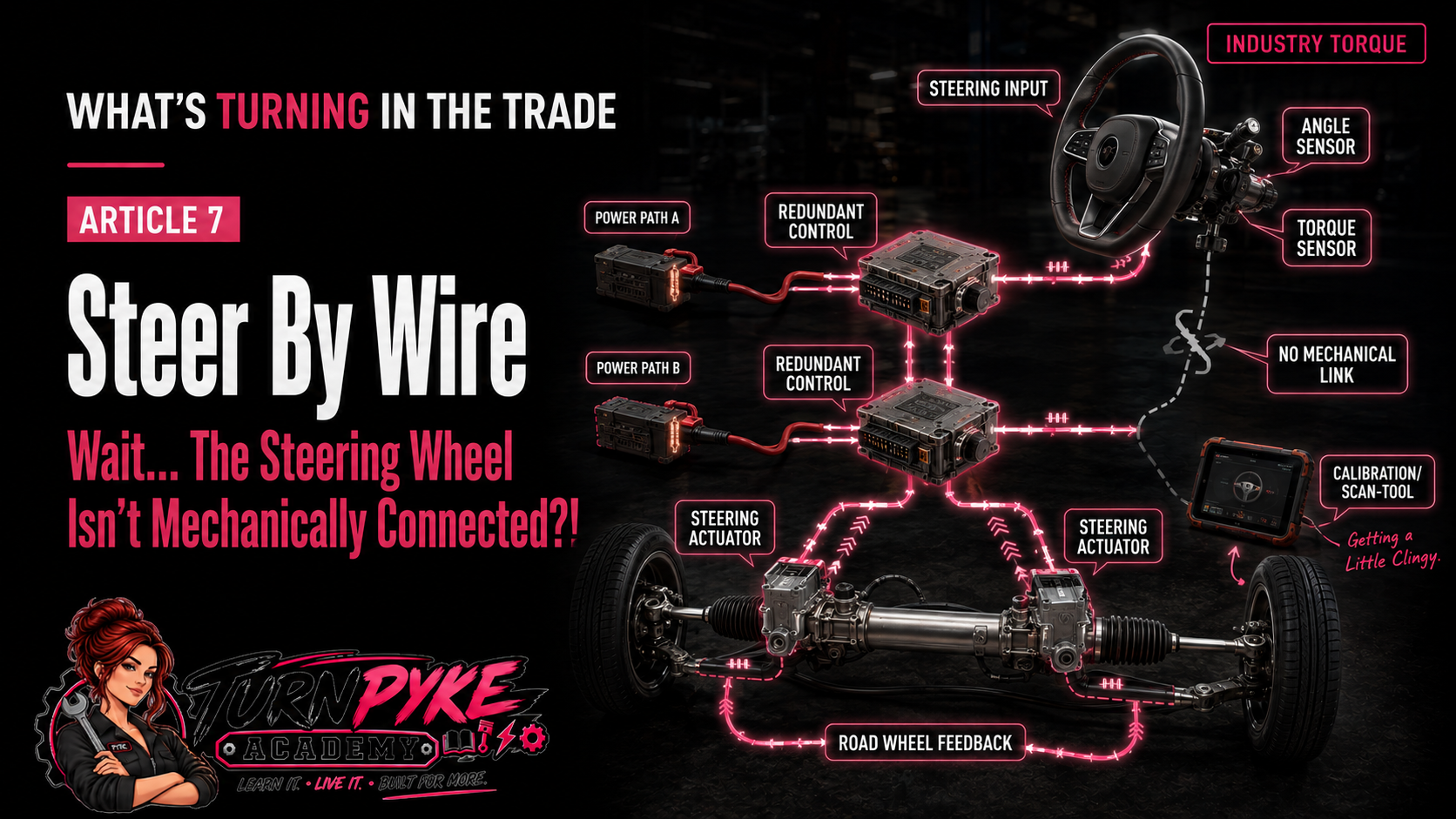
For roughly the entire history of the automobile, we have enjoyed one particularly comforting arrangement.
You turn the steering wheel. Something mechanical connects that steering wheel to the steering gear. The road wheels turn. Everybody understands the assignment.
Then engineers looked at this perfectly reasonable system and apparently said, "What if we removed the part where they are physically connected?"
I'm sorry. What?
Welcome to steer by wire.
A steering system where the driver's input can be transmitted electronically instead of through a permanent mechanical connection between the steering wheel and the road wheels.
And before every old school technician within a 50 kilometre radius begins yelling "ABSOLUTELY NOT," there is considerably more going on here than somebody replacing a steering shaft with Bluetooth and hoping for the best.
1. What happened?
Steer by wire is moving from interesting engineering experiment to real production vehicle technology.
Mercedes Benz announced in April 2026 that its new EQS will be available with steer by wire. ZF, which supplies the technology, describes a system that replaces the fixed mechanical connection between the steering wheel and road wheels with an electronic connection controlled through sensors, actuators and software.
Nissan has already used Direct Adaptive Steering, an earlier design that electronically communicates driver input to control units and steering actuators while retaining a mechanical backup clutch in that implementation.
What is changing now is how far the technology is going. Newer designs can eliminate the permanent mechanical connection during normal operation.
The steering wheel asks for steering. Electronics interpret the request. An actuator at the steering gear makes it happen.
Somewhere, an old school technician just felt a disturbance in the Force.
2. How does it work?
Traditional steering
A conventional path is steering wheel to steering column to intermediate shaft to steering gear to tie rods to road wheels.
Electric power steering may add a motor for assist, but there is still a physical path between your hands and the steering gear.
Steer by wire separates input from output
Sensors detect what the driver asks for. A control unit interprets the request. An electronic signal travels to a steering actuator. The actuator moves the steering gear and turns the road wheels.
ZF describes its system as using a steering wheel actuator that detects driver input and a separate mechatronic actuator that creates steering force at the road wheels.
Where did the steering feel go?
With a mechanical system, tire and road forces travel back through the steering system. With steer by wire, that direct physical feedback is gone, so the system creates steering feel electronically.
A feedback actuator can generate the resistance and road feel the driver experiences. Software can decide how heavy steering feels, how much road disturbance reaches the driver and how steering feel changes with speed.
Mercedes Benz says its system calculates forces at the steered wheels and recreates appropriate feedback while filtering unwanted vibration.
The vehicle can essentially say, "You need to know the tires are loading up in this corner," while also deciding, "You probably do not need to experience every expansion joint directly through your wrists."
Honestly? Reasonable.
The steering ratio can change
Because there is no fixed mechanical relationship, the system can use different steering ratios depending on conditions.
At low speed, a small steering wheel movement can produce a larger road wheel angle for easier parking. At high speed, the same steering wheel movement can produce a smaller road wheel angle for stability.
At this point I am surprised the cup holders do not require initialization.
What happens if something fails?
There it is. The question every technician asked four seconds into this article.
"Emily. THERE IS NO STEERING SHAFT. WHAT HAPPENS WHEN THE COMPUTER DIES?"
Fair question.
Safety critical steer by wire systems rely heavily on redundancy. Mercedes describes redundant signal paths, high precision sensors and powerful control units intended to maintain steering capability even if a fault occurs. It also describes additional vehicle control support through rear axle steering and targeted wheel braking in an extreme failure scenario.
So no, engineers did not simply remove the steering shaft, slap the hood and say, "The WiFi seems pretty reliable."
Losing radio presets is inconvenient. Losing steering is rather more frowned upon.
3. Why should technicians care?
Steer by wire changes what a steering problem can look like.
Traditional diagnosis may lead to ball joints, tie rods, racks, shafts, columns, electric assist motors, alignment and suspension geometry. Steer by wire adds steering angle sensors, driver input sensors, control modules, communication networks, electric actuators, feedback motors, power supplies, software, calibration and redundant circuits.
A customer may complain, "The steering feels weird." Excellent. The most scientifically precise complaint ever delivered to a service advisor.
On a steer by wire vehicle, "feels weird" could involve how the system is generating steering feedback, not only mechanical friction or alignment.
Alignment becomes even more interesting
Because apparently every new technology eventually finds a way to make the alignment rack more complicated.
The system still needs to understand driver input, steering position, road wheel angle, vehicle direction and sometimes rear wheel steering position. Steering angle information, geometry, initialization and calibration procedures matter enormously.
You cannot assume that because the steering wheel looks straight, every electronic steering value agrees.
Steer by wire takes our ADAS lesson and gives it espresso.
Diagnostic scans become essential
Technicians may compare commanded steering angle, actual road wheel position, steering wheel angle, driver torque input, actuator status, feedback motor operation, supply voltage, communication and calibration data.
The principle remains simple: what is being commanded, what is actually happening, and do they agree?
Power and ground have entered the chat again
You can create the world's most sophisticated steer by wire system with redundant processors, precision sensors and advanced software. Guess what? The modules and actuators still require proper electrical power.
The technology is futuristic. The corroded connector absolutely is not.
Automotive diagnosis remains committed to humility.
Service information matters
Replacing a steering component may involve initialization, calibration, programming, steering angle learning, actuator setup, alignment prerequisites and manufacturer scan tool functions.
Not "I've done a rack before." Cool. This rack can electronically decide how your steering wheel feels. Maybe give the manual a little peek.
Safety changes too
Steer by wire is safety critical electronics. Electrical isolation, actuator movement, calibration and diagnostic commands may require specific precautions.
Also maybe do not put your fingers somewhere an electrically driven steering actuator can suddenly decide "FULL LEFT."
Hands are useful. We like keeping them.
4. What should an apprentice remember?
Steer by wire separates steering input from steering output.
The driver requests a movement. Sensors measure it. Computers interpret it. Actuators move the wheels. Another actuator can recreate steering feedback for the driver.
The steering ratio and feedback can become electronically controllable.
But the main apprentice takeaway is not to memorize one manufacturer's system. Understand inputs, controller decisions, outputs and feedback.
Input: what does the driver request?
Controller: what does the module decide?
Output: what does the actuator do?
Feedback: did it happen?
Congratulations. We have taken terrifying modern technology and discovered basic diagnostic logic hiding underneath it wearing sunglasses.
5. The C of Q Connection
The C of Q is much more likely to test underlying principles than one manufacturer's exact steer by wire architecture.
Understand steering geometry, toe, caster, camber, steering angle sensors, torque sensors, electric motors, position sensors, module inputs and outputs, network communication, power and ground testing, scan tool diagnosis, initialization, calibration and fail safe strategies.
Never confuse the command with the result. If commanded steering changes normally but actual actuator position does not respond, the system has understood the driver's request and the fault lies farther down the chain.
If an electronically controlled steering vehicle has intermittent assist loss, communication DTCs and battery voltage below specification, correct the low voltage condition before replacing expensive steering electronics.
Do not diagnose a safety critical computer system while the vehicle is trying to survive on nine volts and a prayer.
6. Sources
Mercedes Benz, Steer By Wire Becomes Reality in the New EQS, April 2026:
https://group.mercedes-benz.com/technology/innovation/development/steer-by-wire.html
ZF, Steer By Wire:
https://press.zf.com/press/en/releases/release_89553.html
Nissan, Direct Adaptive Steering:
https://www.nissan-global.com/EN/INNOVATION/TECHNOLOGY/ARCHIVE/DIRECT_ADAPTIVE_STEERING/
OEM service information remains the final authority because steer by wire architectures, backup strategies, sensors, actuators and calibration procedures vary by vehicle.
Do not read one article, walk up to an unfamiliar steering system and announce, "I understand all steer by wire now." That is precisely how the automotive gods decide it is time to humble you.
7. Next Step
DAILY TORQUE
A steer by wire vehicle detects the driver's steering request correctly, but scan data shows that the commanded road wheel position is not being achieved.
Which area should the technician investigate NEXT?
A. Steering actuator operation and its related circuits
B. Steering wheel trim and airbag cover position
C. Tire tread depth at the non steering axle
D. Cabin temperature sensor calibration
Correct Answer: A. Steering actuator operation and its related circuits.
The system has recognized the driver's steering input, but the expected output is not happening. Move farther down the chain toward actuator operation, power, ground, control circuits, communication and mechanical movement.
B may make the steering wheel prettier. Unfortunately, aesthetics have not yet been proven to control tie rod movement.
D is HVAC desperately trying to involve itself in another article. Absolutely not. Go home, HVAC.
Apprentice Takeaway: If the input is correct but the output is wrong, move your diagnosis farther down the chain.
At TurnPyke Academy, we take intimidating new technology and drag it back to fundamentals: what goes in, who makes the decision, what comes out, and did it actually happen?
We spent more than a century mechanically connecting the steering wheel to the wheels. Engineers have now decided that relationship was getting a little clingy.
Knowledge. Confidence. Drive.