
Automotive technology has always changed.
Carburetors became fuel injection. Distributors gave way to electronic ignition. Hydraulic steering became electric power steering. Mechanical throttle cables became electronic throttle control.
Technicians adapted.
But the change happening now is a little different.
We aren't just getting another new component or another system to learn.
The basic architecture of the vehicle is changing.
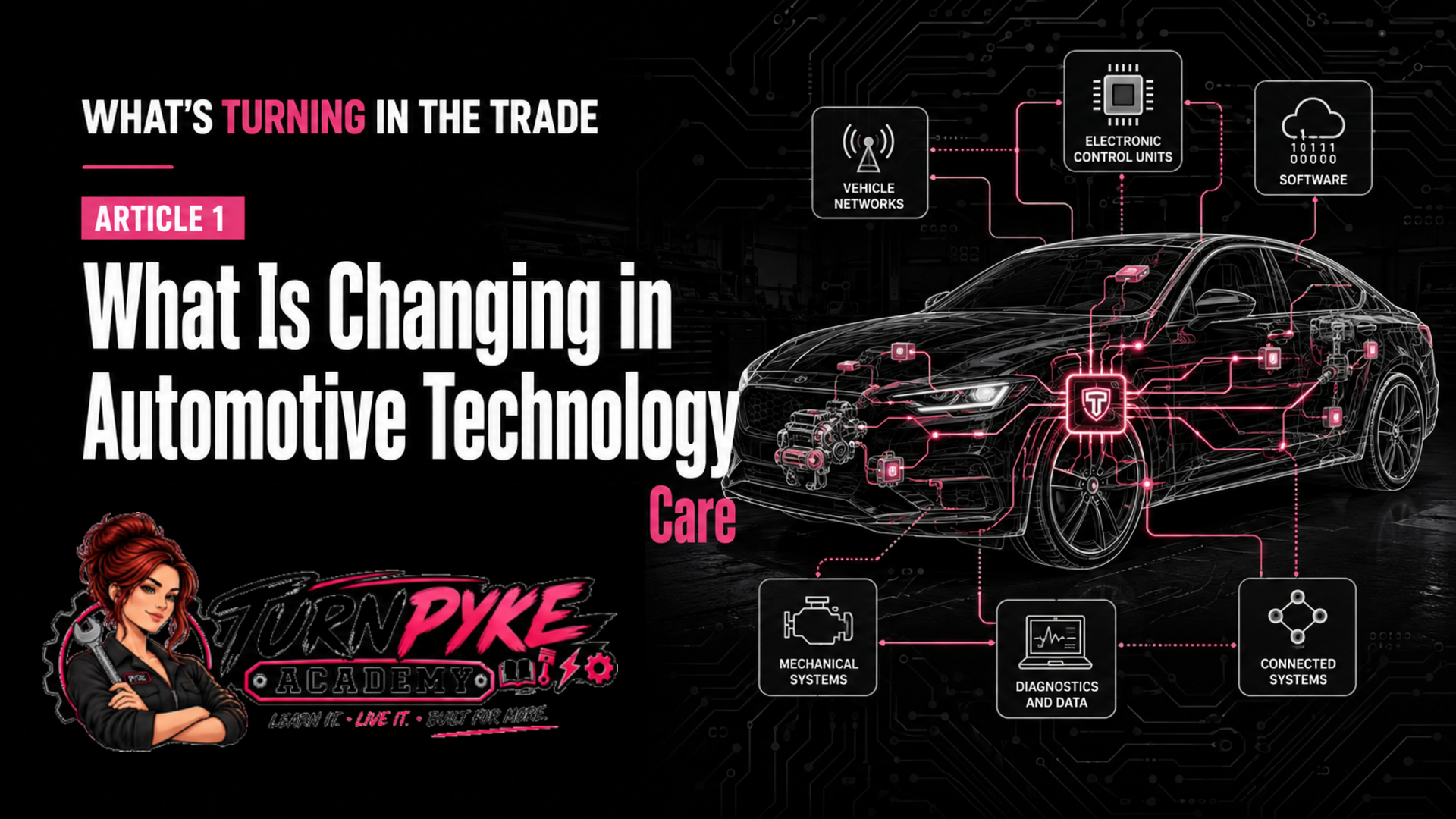
Modern vehicles are moving away from dozens of individual systems each doing their own little job and toward vehicles where hardware, electronics, communication networks and software operate as one deeply connected system.
The industry calls these software defined vehicles.
That sounds suspiciously like something dreamed up by engineers to make apprentices cry, so let's translate it into shop language.
1. What happened?
For decades, manufacturers added more electronic features to vehicles by adding more electronic control units.
Need electronic fuel injection? Add a controller.
ABS? Controller.
Airbags? Controller.
Body electronics? Controller.
Transmission? Another controller.
As vehicles gained more features, the number of computers, wiring circuits and communication requirements kept growing.
That approach works, but there is a point where continuously adding separate modules becomes incredibly complicated.
So manufacturers are beginning to change the way vehicles are built.
Instead of having a separate computer responsible for almost every individual function, newer vehicle designs are beginning to consolidate those functions into fewer, more powerful computers connected through high speed networks.
The International Energy Agency describes this as a shift from traditional distributed electronic architectures toward centralized and zonal architectures, where fewer computers can control many different areas of the vehicle.
And this is not a hypothetical vehicle of the future conversation anymore.
In plain English: The car is becoming less like a collection of separate computers bolted together and more like one big network where everything talks, shares information and depends on everything else.
Which is incredibly clever. And occasionally incredibly annoying when you're the person trying to figure out why it doesn't work.
2. How does it work?
Let's imagine an older electronic vehicle architecture.
- Engine Control Module
- Transmission Control Module
- ABS Module
- Body Control Module
- Airbag Module
- HVAC Module
- Power Steering Module
Each module has a specific responsibility. They communicate with each other when necessary, but much of the processing happens inside the individual controller.
Newer vehicle architecture is beginning to look different.
Instead of continuously adding individual computers, manufacturers can use larger centralized computers along with zonal controllers positioned around the vehicle.
A zonal controller looks after devices located within a physical section of the vehicle rather than being dedicated to only one system.
For example, instead of running long individual circuits from several components back to several different modules, components in one area of the vehicle may connect to a nearby zonal controller. That information can then travel across a high speed vehicle network to the central computer.
The result can mean:
- Fewer individual controllers
- Less wiring
- Faster communication
- More information shared between systems
- More vehicle functions controlled through software
General Motors, for example, has described plans for a centralized computing architecture connected through a high speed Ethernet backbone. Renault has also described centralized computers working with zonal systems rather than relying on large numbers of separate ECUs.
And then we add software.
This is the really important part.
In a software defined vehicle, the physical hardware installed in the vehicle doesn't necessarily determine everything that vehicle will ever be capable of doing. Software increasingly controls how that hardware behaves.
That means manufacturers can potentially change vehicle functions through programming and over the air updates, sometimes without the vehicle ever entering a shop.
Software updates can be used for things such as:
- Correcting software faults
- Updating vehicle functionality
- Improving performance
- Installing cybersecurity updates
- Changing battery management strategies
- Updating driver assistance functions
- Adding new features
Your phone updates its software overnight. Cars are increasingly capable of doing something similar. Except your phone generally doesn't weigh 2,000 kg and control your steering and brakes. So we should probably pay attention.
3. Why should technicians care?
Because this changes how we diagnose vehicles.
Traditionally, technicians are taught to identify the system containing the fault. Engine problem? Go to the engine system. ABS problem? Go to ABS. HVAC problem? Go to HVAC.
That approach isn't disappearing. But when vehicle systems become more interconnected, a symptom appearing in one system may be caused by information coming from somewhere completely different.
The technician therefore has to start asking different questions:
- Where does this system get its information?
- Which computer makes the decision?
- What other modules are involved?
- Is the information actually reaching the module?
- Is the module configured correctly?
- Is there a software update affecting this problem?
- Does something require programming or initialization after replacement?
That's a major diagnostic shift.
Service procedures can change too.
Replacing a component may no longer end with: Remove broken part. Install new part. Send it.
A modern repair might also require:
- Scanning the vehicle before repairs
- Scanning after repairs
- Performing an initialization
- Completing a relearn procedure
- Programming a replacement module
- Confirming software versions
- Performing calibration
- Checking communication faults
- Following manufacturer specific service information
Your scan tool becomes even more important.
But knowing how to use a scan tool isn't the same as knowing how to diagnose.
A scan tool might tell you: Lost communication with module.
It doesn't necessarily tell you why. Is the module dead? Missing power? Missing ground? Is the network open? Shorted? Is another module pulling the network down? That's where your fundamentals come roaring back into the conversation.
4. What should an apprentice remember?
The fundamentals are not becoming obsolete. They're becoming more important.
You don't need to memorize every new vehicle architecture manufacturers create. You probably couldn't even if you tried. But you do need to understand the principles underneath them.
Voltage is still voltage.
A circuit still requires a complete path.
Excessive resistance can still create voltage drop.
Modules still require proper power and ground.
Sensors still provide information.
Actuators still perform work.
Computers still make decisions based on inputs.
Networks still require functioning circuits to communicate.
The packaging is changing. The physics isn't.
And this is exactly why apprentices should understand why something works instead of memorizing that Pin 4 should magically have 5 volts because the service manual said so.
5. The C of Q Connection 🔧
You probably aren't going to open your 310S C of Q exam and see: Please describe the complete architecture of a software defined vehicle. Thankfully.
But the principles underneath these vehicles are already incredibly important. Pay close attention to:
- Electrical fundamentals
- Power and ground testing
- Voltage drop
- Wiring diagrams
- Sensors and actuators
- Module inputs and outputs
- Serial data communication
- CAN network operation
- Scan tool data
- Diagnostic trouble codes
- Diagnostic strategy
- Programming versus component failure
- Relearn and initialization procedures
A module stops communicating. The answer should not automatically be: Replace the module. You may need to verify power, ground, communication circuits and network integrity first. Then condemn the module.
That's old school electrical diagnostic logic applied to very modern technology. And that's exactly the point.
6. Sources
International Energy Agency: Vehicle Software and Software Defined Vehicles
Explains the shift from distributed ECUs toward centralized and zonal vehicle architectures and the growing role of software and over the air updates.
https://www.iea.org/reports/vehicle-software-and-software-defined-vehicles
AIA Canada: Software Defined Vehicles: How Will They Impact Our Auto Care Sector?
Canadian perspective on how software defined vehicles are changing vehicle maintenance, diagnostics and aftermarket repair.
https://www.aiacanada.com/news/software-defined-vehicles-how-will-they-impact-our-auto-care-sector/
General Motors Engineering
Example of centralized computing and high speed vehicle Ethernet architecture.
Renault Group: Software Defined Vehicle Technology
Example of centralized computers and zonal control.
https://www.renaultgroup.com/en/popin/tech-ready/
7. Next Step 🔧
The more computers we put into vehicles, the more important one very old diagnostic lesson becomes: Before you blame the expensive thing, prove the circuit can actually support the load.
Next article: Why Voltage Drop Testing Finds Problems an Ohmmeter Can Miss.
At TurnPyke Academy, we don't just memorize which answer is correct. We work through why it's correct so you can recognize the same principle when the wording or the vehicle changes.
Knowledge. Confidence. Drive.