There is a very specific type of frustration that comes from reading a C of Q question, knowing the system, knowing the repair, knowing what you would do in the shop…
…and still staring at four answers like one of them has personally betrayed you.
Because sometimes the problem is not that you do not understand automotive.
Sometimes the problem is that the question is testing how carefully you read, how well you understand diagnostic order, and whether you can separate “technically possible” from “BEST answer.”
Which feels unfair.
Because out in the shop, the vehicle does not usually hand you four multiple choice answers and politely ask what you would like to do next.
The C of Q does.
And occasionally, all four answers look like they were written by someone who woke up and chose violence.
1. What happened?
The Certificate of Qualification exam does not only test whether you know automotive systems. It also tests whether you can apply that knowledge in the correct diagnostic sequence.
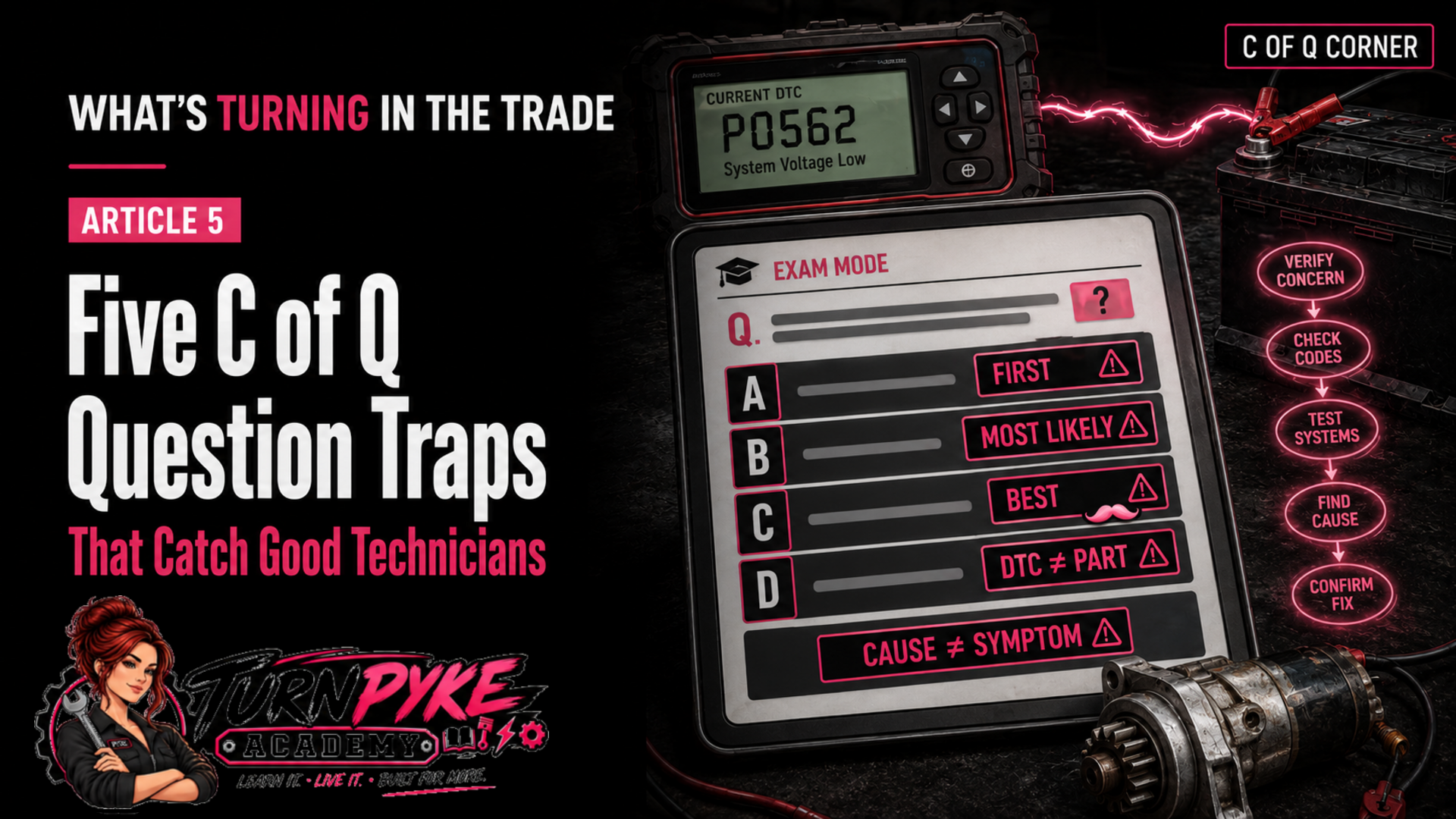
FIRST. BEST. MOST likely. NEXT.
Those words matter. A lot.
A question may give you four answers that are all technically possible. But only one fits the information given and the order of diagnosis.
That is where apprentices get into trouble. They read the symptom, recognize a failure they have seen before, and immediately jump to the repair they remember.
Meanwhile, the question is asking: What should you test first? Not: What eventually turned out to be broken on that Silverado you worked on six months ago? Huge difference.
The goal is not to become better at guessing. The goal is to learn how to read the question like a diagnostic procedure.
2. How does it work?
Trap #1: Ignoring the word FIRST
Imagine the question says: A vehicle has low fuel pressure and a hard start condition. What should the technician check FIRST?
You immediately think: Fuel pump. Maybe.
But if one answer says verify fuel pressure with a gauge and another says replace the fuel pump, the test comes before the replacement. Even if the pump eventually turns out to be the problem.
FIRST means diagnostic order.
Ask: What information do I still need before I am allowed to condemn something? Because apparently the exam is very opposed to replacing $900 components based on vibes. Fair.
Trap #2: Picking something possible instead of MOST likely
Imagine an engine has low compression on one cylinder. Possible causes could include a burned valve, broken piston ring, damaged piston or head gasket leak.
Now the question adds: Adding oil to the cylinder causes compression to increase significantly.
The oil temporarily helps seal the piston rings, so the clue points toward ring or cylinder sealing.
Which answer fits ALL the information best?
The second half of the question often contains the clue that murders three of the answers. Read the whole thing. The exam writers put those words there for a reason. Probably.
Trap #3: Replacing the component named in the DTC
A diagnostic trouble code says: Oxygen sensor circuit low voltage. Therefore: Replace oxygen sensor. Absolutely not. Put the parts cannon down.
A DTC identifies the system or condition the module detected. It does not necessarily identify the failed component.
- Sensor failure
- Open circuit
- Short to ground
- Poor connection
- Power supply problem
- Ground issue
- Wiring damage
Same thing with communication codes. Lost communication with ABS module does not automatically mean the ABS module has died and you should immediately begin emotionally preparing for programming.
A code gives you a direction. Not a permission slip to start firing parts at the vehicle.
Trap #4: Confusing a symptom with a cause
Brake pedal pulsates during braking. That is the symptom. Brake rotor lateral runout may be a cause.
A useful trick is to ask: Does this answer actually explain the symptom? If it just restates the complaint in fancier words, it probably is not doing much for you.
It is the multiple choice equivalent of asking “Why is the car overheating?” and answering “Because the temperature is too high.” Thank you, detective.
Trap #5: Ignoring the information they already gave you
The question says the battery is fully charged. Then one answer says charge the battery. No.
The question says fuel pressure meets specification. Then one answer says replace the fuel pump. Also no.
The question says power and ground at the module are correct. Then one answer says repair the module ground. Again: no.
If the question says something has been tested and confirmed good, cross it off mentally.
It is done. Move on. The exam is not inviting you to argue with its fictional technician.
3. Why should technicians care?
Because this is not just exam strategy. This is diagnostic strategy.
- What is the complaint?
- Can I verify it?
- What systems could cause it?
- What test will eliminate the most possibilities?
- What does that result tell me?
The C of Q is often trying to test exactly that thought process. Which is why somebody with years of shop experience can still struggle if they read the question like trivia instead of diagnosis.
You may know the system. But if you skip the words FIRST and BEST, the exam will happily watch you walk directly into the wrong answer. It has no mercy. It is a PDF with no emotions.
Shop habits can actually trip you up
In the shop, experience creates shortcuts. You see make, model and symptom and your brain goes: “Oh, I know what this is.” Sometimes you are right. Experience is incredibly valuable.
But on the exam, you cannot assume information that the question has not given you. Treat the fictional vehicle like you have never seen it before. A slightly rude little mystery box.
Diagnose what is written.
4. What should an apprentice remember?
Before choosing an answer, ask yourself:
- What exactly is the question asking me to do?
- What information has already been confirmed?
- Which answer explains all the symptoms?
- Am I testing before replacing?
- Am I adding information that is not in the question?
Do not diagnose the vehicle you remember from work. Diagnose the vehicle described in front of you.
The exam does not care what happened to Steve’s F 150 last Thursday. Steve has suffered enough.
5. The C of Q Connection 🔧
Well. This entire article is the C of Q connection. We have finally achieved maximum efficiency.
The exam often tests your diagnostic process more than your memory.
Technical knowledge matters. You absolutely need to understand electrical systems, engines, fuel, brakes, steering, suspension, HVAC, driveline, transmission, diesel, hybrid and EV, safety, and specifications and clearances.
But once you know the systems, you still have to answer: What should happen next?
A quick example
DAILY TORQUE 🔧
A vehicle cranks slowly. Battery state of charge and battery condition have both been confirmed good. Battery terminals are clean and tight. What should the technician do NEXT?
A. Replace the starter motor
B. Charge the battery
C. Perform voltage drop testing on the starter circuit
D. Replace the positive battery cable
Correct Answer: C: Perform voltage drop testing on the starter circuit
Battery condition has already been confirmed. The starter and positive cable have not been proven faulty. Voltage drop testing gives more diagnostic information before replacing anything.
Apprentice takeaway: Given the information in the question, choose the logical next diagnostic step, not the part you remember failing on another vehicle.
That is the game.
6. Sources
Skilled Trades Ontario
Official Ontario information for apprenticeship certification, Certificate of Qualification requirements and trade examinations.
https://www.skilledtradesontario.ca/
Red Seal Program: Automotive Service Technician
The Red Seal Occupational Standard outlines the major task areas and technical competencies expected of Automotive Service Technicians across Canada.
https://www.red-seal.ca/eng/trades/autoservtech.shtml
For real world diagnosis, always follow OEM testing procedures, specifications and repair information for the vehicle being serviced. Because the C of Q may only have four answers. The vehicle in your bay has approximately 4,700.
7. Next Step 🔧
DAILY TORQUE 🔧
A common rail diesel engine cranks normally but does not start. Desired rail pressure rises during cranking, but actual rail pressure remains far below the minimum value required for starting. Which area should the technician investigate FIRST?
A. DPF differential pressure sensor operation
B. EGR valve position and command
C. High pressure fuel delivery and injector return flow
D. Downstream NOx sensor operation
Correct Answer: C: High pressure fuel delivery and injector return flow
The question has already handed you the important clue: actual rail pressure is too low for starting. The answer that directly addresses the failed condition is the high pressure fuel system and injector return flow.
A concerns DPF pressure monitoring.
B concerns EGR operation.
D concerns aftertreatment monitoring.
Apprentice takeaway: Follow the clue the question gives you. Do not get distracted by impressive sounding components that have nothing to do with the failed condition. The exam loves shiny objects. Ignore them.
If C of Q questions currently make you feel like “I KNOW THIS. WHY AM I GETTING IT WRONG?” that is exactly the kind of thing we work on at TurnPyke Academy.
Sometimes the issue is not missing technical knowledge. Sometimes you need to slow the question down, identify what it is actually testing, and stop letting the word BEST sneak past you wearing a fake moustache.
We learn the system. We learn the diagnostic process. And then we learn how the exam tries to ask about both.
Knowledge. Confidence. Drive.